1. Introduction: Brand Description, Core Positioning, and Target Audience
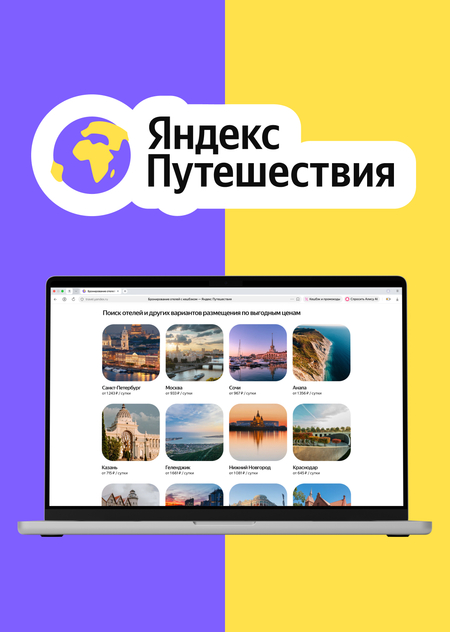
Yandex Travel is a Russian online travel service within the Yandex ecosystem. It helps users search for and book hotels, flights, train tickets, bus tickets, and package tours. For users, the platform works as a single entry point for planning a trip: it gathers travel options, organizes them into comparable formats, and supports the booking process in one digital environment.
The brand is positioned as a convenient and trustworthy travel aggregator. Its key promise is simplicity: users can compare options, check prices, read reviews, and move from search to booking without switching between many services. In recent campaigns, Yandex Travel also emphasizes price transparency by stating that hotel prices come directly from hotels.
A second important part of the positioning is ecosystem integration. Yandex Travel is connected to Yandex Plus and other Yandex services, which makes travel booking feel like a natural continuation of the user’s everyday digital routine. Cashback in Plus points also adds a loyalty mechanism and gives users a practical reason to return to the platform.
The target audience is broad, but it mainly includes digitally active Russian travellers who value convenience, price clarity, and reliable information. The service is relevant for several groups: • Leisure travellers planning domestic or international trips, including families, couples, and solo travellers. • Business travellers who need fast and reliable booking of accommodation and transport. • Price-sensitive users who compare options and react to discounts, cashback, and direct-price messages. • Yandex ecosystem users who already interact with the company’s services and may discover travel offers through familiar digital channels.
Overall, Yandex Travel communicates itself not only as a booking tool, but as a practical assistant for people who want to make travel planning clearer, faster, and less risky.
2. Communication Channels: Public Field, Social Media, and PR Strategies
Two theoretical lenses used to analyze Yandex Travel communication.
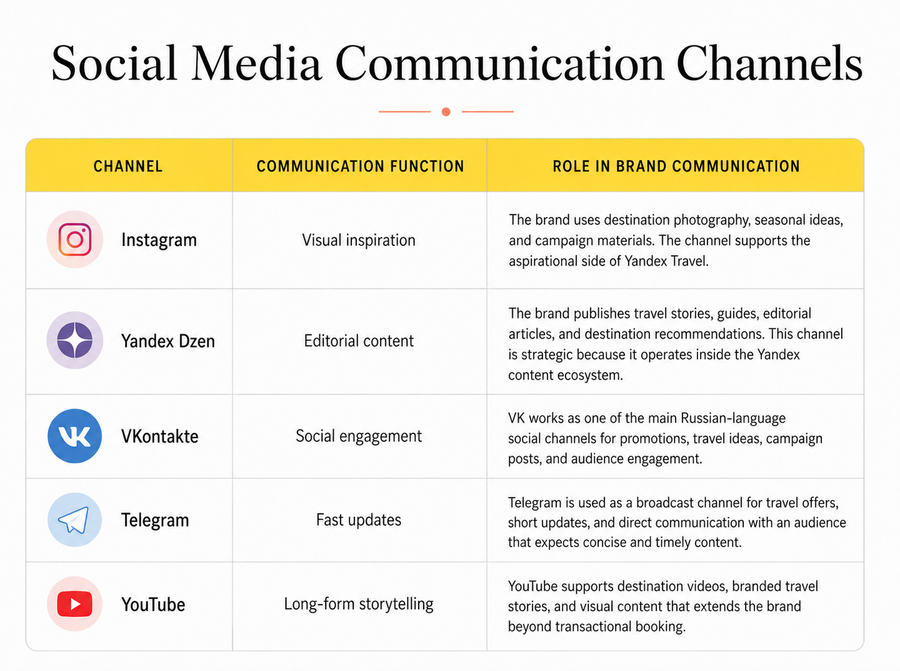
Yandex Travel’s social media strategy is built as a multi-channel communication system in which each platform performs a distinct function. Together, these channels combine inspiration, information, engagement, and storytelling, allowing the brand to maintain a consistent presence across different audience habits and content formats.
Content Marketing: Yandex Travel Journal
One of the strongest owned media channels is Yandex Travel Journal. It publishes travel ideas, routes, reviews, guides, quizzes, and editorial materials. This helps the brand act not only as a booking platform, but also as a source of travel knowledge and inspiration.
The Journal also supports domestic tourism by highlighting regional destinations, local routes, and places that may be less visible in mainstream travel media. This strengthens Yandex Travel’s role as a guide to different forms of travel across Russia.
User-generated and community-oriented formats, such as reader stories or contests, add another layer of engagement. They make the platform feel less like a purely commercial service and more like a shared travel environment.
PR Strategy: The «Приятно остановиться» Award
A notable PR initiative is the «Priyatno Ostavatsya» award, which recognizes high-performing properties on the platform. The name works as a wordplay: it turns a familiar farewell phrase into an invitation to enjoy staying somewhere.
The award is based on platform data such as bookings, reviews, and service quality indicators. For users, the award badge works as a trust signal. For hotels, it becomes a visible quality marker and a reason to communicate their presence on Yandex Travel.
This initiative connects B2B and B2C communication. It strengthens relationships with accommodation partners while also helping users identify reliable options.
Research-Driven PR and Ecosystem Communication
Yandex Travel strengthens its brand communication not only through direct promotions, but also through broader visibility strategies. One of them is research-driven PR: the brand uses statistics and travel-related data to comment on tourism habits, domestic travel, road trips, and seasonal preferences. This helps Yandex Travel appear as an expert in travel behavior, rather than only as a booking service.
At the same time, the platform benefits from ecosystem-based communication. As part of the broader Yandex ecosystem, Yandex Travel can be promoted through search, maps, loyalty mechanics, and other Yandex services. This creates an always-on communication environment in which travel offers remain close to the user’s everyday digital activities.
3. Theoretical Framework
To analyze Yandex Travel, this project uses two communication theories: Uses and Gratifications Theory and the Elaboration Likelihood Model.
Two theoretical lenses used to analyze Yandex Travel communication.
Together, these theories help explain how the service works as a communication system: why users come to it and how it persuades them to make travel decisions.
Yandex Travel is not only a platform for booking hotels, flights, trains, and buses. It is also an interface where users search for information, compare options, evaluate risks, and build confidence before making a choice. In this context, communication is embedded in prices, filters, ratings, reviews, maps, badges, destination images, and booking conditions.
Uses and Gratifications Theory helps identify what needs users expect the service to satisfy. The Elaboration Likelihood Model explains how the platform combines rational arguments with quick visual and emotional cues.
Uses and Gratifications Theory
Uses and Gratifications Theory views users as active participants who choose media and digital services to satisfy specific needs. In the case of Yandex Travel, users interact with the platform not only to complete a booking, but also to make travel planning clearer, faster, and less stressful.
For this analysis, four user needs are especially relevant: information, convenience, confidence, and inspiration. Users need information about prices, dates, routes, locations, hotels, and booking rules. They need convenience because travel planning includes many separate tasks. They need confidence because booking involves financial and emotional risk. They may also need inspiration when they explore possible destinations.
Through this theory, Yandex Travel can be analyzed by asking: what user needs does the service address, and how are these needs translated into interface and communication elements?
User needs and corresponding service features in Yandex Travel.
Elaboration Likelihood Model
The Elaboration Likelihood Model explains persuasion through two routes: the central route and the peripheral route. The central route involves careful processing of information. The peripheral route relies on quicker cues, impressions, and associations.
In Yandex Travel, the central route can be seen in prices, dates, filters, hotel descriptions, maps, ratings, reviews, refund conditions, and booking rules. These elements work as rational arguments that help users compare options and justify decisions. The peripheral route works through visual and emotional cues: recognizable Yandex branding, clean interface design, destination photography, badges, icons, and the overall feeling of simplicity and reliability. These elements may not be analyzed deeply, but they shape trust and first impression.
Central and peripheral routes of persuasion in Yandex Travel.
Analytical Lens
The two theories complement each other. Uses and Gratifications Theory explains what users seek from Yandex Travel, while the Elaboration Likelihood Model explains how the service communicates value and persuades users. In the following analysis, we examine how Yandex Travel satisfies four main user needs: information, convenience, confidence, and inspiration. We also look at how the service combines central-route persuasion, such as prices and reviews, with peripheral-route persuasion, such as visual style, badges, and brand recognition.
Main analytical question: how does Yandex Travel use interface communication and brand cues to satisfy user needs and persuade users to make travel decisions?
Analytical matrix for further analysis of Yandex Travel communication.
4. Analysis

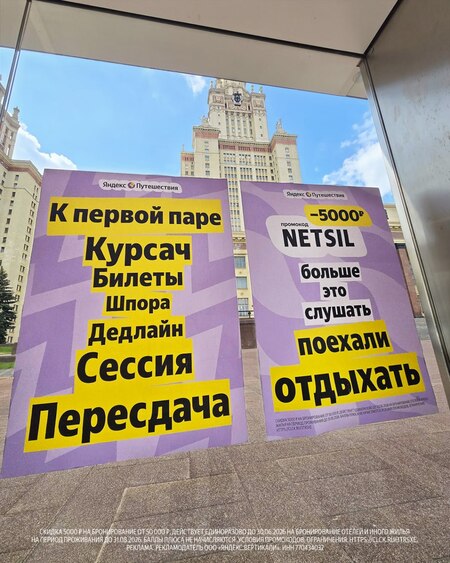
Outdoor campaign addressing routine fatigue and the desire to escape.
Yandex Travel’s outdoor campaign in Moscow speaks to users through the language of everyday exhaustion. The posters list words associated with work, study, deadlines, meetings, feedback, exams, and constant tasks. This creates immediate recognition: the audience sees a compressed version of its own tired routine rather than an abstract travel offer.
The campaign mainly uses peripheral persuasion: bold typography, bright yellow accents, slang-like wording, humor, and emotional identification. The phrase «больше это слушать — поехали отдыхать» turns fatigue into a reason to travel, while the NETSIL promo code adds a concrete booking incentive. From the perspective of Uses and Gratifications Theory, the campaign addresses escape, emotional relief, and inspiration. The discount offer also adds a central-route argument: users receive a rational reason to book through the service.


Outdoor and street-level campaign communicating direct hotel prices.