KidsCube
modular furniture for children’s rooms
1. The author’s reasoning about how communication theory works in the field of design or contemporary art
Communication theory is at the heart of design, and works as a tool for transmitting information from creators (designers) to recipients (target audience and consumers). It relies on several functions that adapt to everyday life, helping users to perceive information quickly and effectively. The message is conveyed through shapes, colors, typography, and infographics that are on various media: posters, websites, packages, and more.
Communication theory captures several basic principles that help creators deliver information to consumers simply and efficiently.
1 — Past experience is taken into account: interpreting data based on time frames
2 — There must be a commonality between the sender and the recipient of the information.
3 — Direct connection to marketing: combines aesthetics, empathy and presentation of ideas.
The stages of communication in design begin with audience analysis: experience, expectations, and motivation determine the choice of signs and symbols. The second stage is the choice of the structure: visual and printed components.
Our project is based on interior design and is dedicated to the development of modular furniture systems for children’s rooms. That is why it is worth paying attention to the work of communication theory in interior design.
Communication theory describes space as a means of transmitting information from the designer to the user through an interior element. Shapes, colors, and textures convey ideas, emotions, and values. The designer, as the sender, forms the image through the composition of the room, and the user influences the decoration of the space. This creates not only convenience, but a full-fledged dialogue that shapes behavior and perception.
The stages of applying communication theory in interior design begin with a pre-design analysis, which identifies preferences, needs and helps in drawing up a technical specification, which later creates a full-fledged design project. Coding takes place through zoning, color schemes for emotions and intuitive reading of the space.
2. Presentation of our brand for a general audience
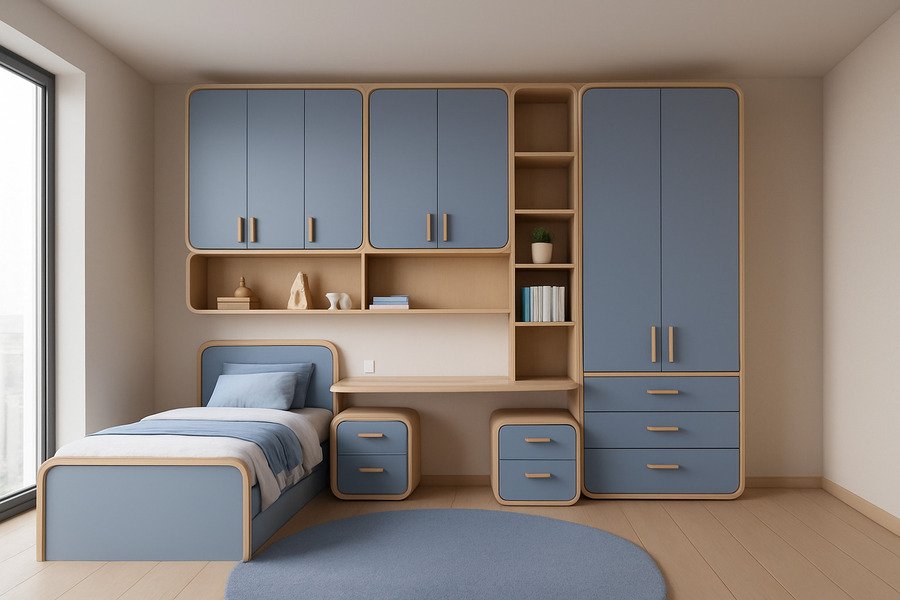
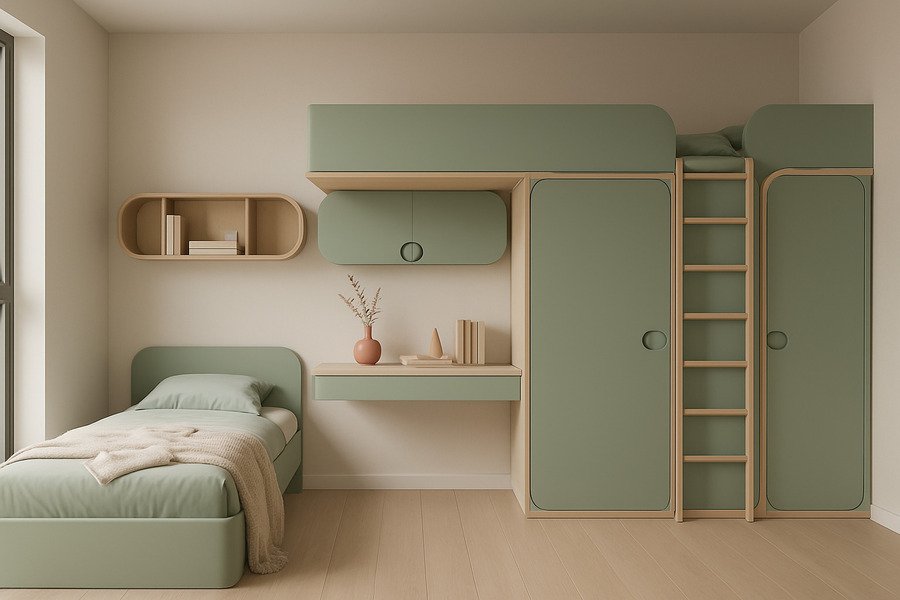
The KidsCube brand is a company that develops modular furniture for children’s rooms, which is especially convenient for small spaces. The main difference from ordinary furniture, which consists of solid large elements, is that KidsCube furniture consists of separate blocks and modules. Modules can be combined, rearranged and supplemented at the discretion of users.

KidsCube modules save space and can be positioned to maximize the use of every inch of small rooms. For example, you can build a closet into a niche or make a bed with storage drawers.
Flexibility and adaptability are also important features. As the child grows, you can change the configuration of the furniture — add modules or remove unnecessary ones. For example, you can make a full-fledged sofa or workplace out of a baby’s crib.
Versatility is another advantage of modular furniture. Modules often combine several functions. There may be a workplace in one block and a desk in the other. Also, one module can be rearranged for different purposes, for example, first for games, and later for studying.
The target audience of modular furniture for children’s rooms is families with children aged 0 to 14 years who are looking for functional and flexible solutions for arranging an apartment with limited space, where it is important to optimize every inch.
For such a wide target audience, it is important that furniture is durable so that it can be optimized.
Most often, parents face several problems regarding furniture for children:
1. Furniture does not grow with children. As a result, you have to buy new furniture every 3-5 years. The KidsCube brand will allow you to purchase furniture once and modify it as the child grows and his needs change.
2. Modern parents want not only a high-quality product, but also a visually beautiful one. Children’s furniture is often bright and colorful, which does not fit into the overall interior of the apartment. KidsCube modular furniture offers a diverse palette and an extensive selection of materials for children’s interiors.
3. Preschool children have a lot of toys. There is not enough space to put away and fold neatly. Constant visual noise. KidsCube modules allow you to adapt the space for different tasks. Add more storage and transform it into a play area during games.
4. The appearance of another child in the family. Modular furniture allows you not to buy completely new furniture for the second child, but with the possibility to purchase separate blocks, transform a nursery for one child into a room for two or more children.
The KidsCube brand allows you to solve a large number of parents' problems thanks to its functional modular blocks and the high-quality approach of designers to a particular project.
Modular furniture for children’s rooms is a flexible solution that allows you to create a room suitable for specific purposes and tasks: playing, studying or relaxing. The furniture is assembled like a jigsaw puzzle and changes as the child grows.
The modules work independently of each other, but they are combined in colors, styles, and sizes. All furniture is light and compact for more convenient adaptation to the space.
KidsCube is an ideal company for creating a multifunctional children’s room of small size.
3. Presentation of our brand for a professional audience
KidsCube Pro — a kids’ room project configurator with pre-calculated ergonomics and a managed product lifecycle
This is not a furniture catalog, it’s an FF& E system (Furniture, Fixtures & Equipment) built to be specified like a real project package. You work with the child’s room as a design kit: every parameter is pre-calculated for age stages (0–3, 3–6, 7–10, 11–14), every module is compatible through a defined matrix, and every dimension follows ergonomic standards. The result: fewer mistakes, less time spent on specification, and a room that can evolve as the child grows.
Our standards
Standard 1: Compatibility matrix, fewer specification errors
You get an interactive matrix: modules on the vertical axis, functions on the horizontal axis, and each cell shows: «compatible» / «requires an adapter» / «incompatible, ” including the required adapter size where relevant. Benefit: no dead-end combinations. Every choice is validated upfront. Approvals move faster because the classic „Will this fit?“ loop is almost eliminated.
Standard 2: Cut sheets for every module (always up to date)
Each module comes with a one-page PDF cut sheet (a product document that typically consolidates key dimensions and installation requirements): photo, overall dimensions (W × D × H, centerlines for fasteners), door/drawer opening depth, load capacity, mounting diagram, and wall-clearance requirements. The document version and update date are visible in the top-right corner, and the full version history is available in your account. Benefit: you can hand a contractor or client a single page and avoid back-and-forth clarification. Versioning also means that if anything changes (handles, depth, hardware, tolerances), it’s immediately visible so the project can be recalculated before it becomes an on-site issue.
Standard 3: Guaranteed SLA and technical support (24 hours, dedicated project manager)
Each project receives a ticket number and one responsible manager. Questions are answered within 24 hours (technical issues, specification, non-standard requests). For complex projects (10+ modules or custom requirements), a dedicated project manager is assigned for the full cycle: from specification through installation to warranty service. Benefit: no getting lost in chats, queues, or „who’s handling this?“ threads. One person has full context and can respond to your contractor late in the evening or on a weekend within SLA, reducing delays and on-site disputes.
Q & A
Q:The client bought a kids’ room and wants to add a module two years later. Will the color match? Will it fit the original design? A: Our reorder policy is designed for 7+ years. We keep the color in production or in an active pool (depending on the RAL/NCS). If a module is discontinued, we provide at least 12 months’ notice and offer a size- and function-compatible alternative. Each module’s lifecycle history is visible in your account.
Q: I work in Revit / SketchUp. How can I place the furniture fast and avoid redesign later? A: You get access to a BIM library (3D models with parameters and constraints) and ready-to-use configurations for typical room sizes (8–10 m², 10–12 m², 12–15 m²). Choose a scenario, adapt it to the room geometry, and export the specification to PDF.
Q: The client needs an exact color to match the project palette. How much does it cost and how long is approval? A: A three-step process. 1) You provide the RAL or NCS code. 2) We produce a physical sample (5 business days). 3) You approve and production starts. Tolerance: ± Delta E 1 (furniture industry standard). If deviation is higher, we redo and recalibrate. Option cost: +5% to the base batch price.
Q: The project is approved, but the client suddenly wants a different bed size. How many changes are allowed? A: Any changes are free up to one week before the order goes into production. After release to production, changes are paid (recalculation, possible batch rework, storage). All changes go through the project manager and are documented (specification version updates are visible in your account).
Q: A defect was discovered on site. How do we return the module, and how long will it take? A: Defect → photo + description → RMA ticket issued within 4 hours → we assess whether it’s a manufacturing defect or damage during delivery/installation. Manufacturing defect: replacement within 10 days + return of the defective part. Damage: we agree on the scenario (partial replacement, repair, delivery insurance terms). Warranty: 3 years for all structures, 1 year for hardware (extendable to 5 years with contract servicing).
Q: Who is responsible for assembly? Do I need to supervise? What kinds of errors happen most often? A: You can order «professional assembly» (our installers) or use your own contractor (we provide instructions and control quality through photo reports). Design supervision is recommended for complex projects (>10 modules). Typical errors: incorrect installation sequence, wrong clearance depth, incorrect fasteners. We provide a step-by-step checklist and a project-specific video guide.
Build a project in 4 steps
Step 1. Space and age-stage analysis
Define: room dimensions (W × D × H), geometry (niches, slopes, projections), the child’s current age, and the planning horizon (one stage / two stages / full cycle 0–14).
Step 2. Choose a configuration from the matrix
Log into your account, open the «Footage Configurator, ” select the area range (your size ± 15%), and set functional priorities (sleep / study / storage / sport). Result: a ready base configuration (module list with dimensions and compatibility). Adapt it to the room geometry (remove/add adapters). Deliverable: export the specification from the configurator in your account (PDF table with modules, dimensions, codes, and pricing).
Step 3. Color approval and palette alignment
Provide the target color (RAL/NCS). We produce a sample (5 business days). You approve (or request recalibration). Production begins. Deliverable: a physical color sample.
Step 4. Final specification sign-off and production release
The project manager validates the final specification (modules, color, timelines, delivery address). You approve, pay (or proceed under contract), and the spec is released to production. You receive notifications on manufacturing lead time, shipment date, and expected delivery date. Deliverable: final specification (version + date), contract, accounting documentation.
Made by designers for designers
KidsCube Pro’s logic comes from design workflows, not from furniture retail. This means:
• System instead of a catalog: not «50 modules to choose from, ” but 10 core functional modules plus a matrix that shows how they combine. • Designers’ thinking: the designer works with the room’s lifecycle, not a one-time purchase; we support this through reorders, upgrades, and versioning. • Pre-calculated constraints: load limits, heights, and compatibility are defined and documented upfront, no surprises on site. • Ergonomics as a standard: every height, depth, and angle is aligned with age-based norms; this isn’t „beautiful furniture that happens to be comfortable, ” but „ergonomics translated into furniture rules.“
We listen to your experience
Feedback form in your account: after every project, you can flag what worked, what didn’t, and which tolerances or constraints were missed. Ready to evolve solutions Specification flexibility: if the project critically needs a different height or dimension, the answer isn’t «impossible». We review the reason and propose scenarios (switch to an adjacent module, custom size, or an alternate solution type). Public backlog: you can see which modules are in development and which are queued for launch, and vote on priority. Transparent constraints: if a module can’t be produced due to technical limits, we explain the «why» and offer alternatives (not «no, ” but „here’s the constraint and here are the options“).
Long-term relationships
Shared pipeline for new projects: if you recommend KidsCube, we support you with referral payouts. Co-development: if you or your studio proposes a new module, we can consider a co-development agreement (you as author; we as manufacturer and distributor).
Designers’ loyalty program
Bronze (after 1 project)
• 5% discount on next projects. • Scheduling priority (your projects move up the queue). • Access to a closed designers’ Slack channel (discussion, questions, ideas).
Silver (after 5 projects or volume > 200K RUB)
• 10% discount. • Dedicated manager across all projects (one person, no rotation). • Monthly consultation (1 hour/month with a technologist / architect). • Your portfolio featured on the KidsCube website (a case study with photos, authorship, and description).
Gold (after 15 projects or volume > 500K RUB)
• 15% discount. • Dedicated manager + dedicated technologist for complex projects. • Quarterly strategy call (your view of the kids’ room market; what you need from a supplier). • Co-marketing: we promote you as a preferred partner; you promote us on your channels (ready-made cases, client templates). • Early access to new modules (see and test prototypes 3 months before launch).
Start your first KidsCube project and get a free consultation
Fill out the form in your account (room size, age, functional priorities). A project manager will propose a base configuration within 24 hours. You can adapt it, approve it, and we’ll calculate the final price. The first consultation with a KidsCube architect is complimentary.
4. A detailed explanation of how the communication theory presented in the online course served as the basis for creating these presentations
1. Theory of Planned Behavior (TPB) (Icek Ajzen)
Definition:
The Theory of Planned Behavior (TPB) explains and predicts behavior in specific contexts by proposing that behavior is largely driven by behavioral intention, which is shaped by attitude toward the behavior, subjective norm, and perceived behavioral control (and perceived behavioral control can also influence behavior directly).
TPB is presented by Ajzen as an extension of the Theory of Reasoned Action, introduced to better account for behaviors that are not fully under volitional control. [Ajzen, I. The theory of planned behavior // Organizational Behavior and Human Decision Processes. 1991. Vol. 50, Issue 2. P. 179–211].
How it is applied in the text:
a) Attitude (a risk-reduction mindset): • Phrase: «Compatibility matrix; no specification errors»
• Meaning: the designer becomes convinced the system reduces professional risk (fewer mistakes, fewer claims from clients)
• Thesis in Standard 1: approval time decreases because the likelihood of returning with «Will this fit?» questions is close to eliminated
• Meaning: reinforces «this makes my work faster and safer»
b) Subjective Norm (what peers expect in the design community): • Phrase: «A system that borrows its logic from design practice, not from the furniture business»
• Meaning: signals that systems thinking is valued in the professional community; choosing KidsCube positions the designer as someone who thinks like an architect, not like a procurement manager
c) Perceived Behavioral Control (control and ease of action): • Phrase: «Step 1. Space and age-stage analysis, ” followed by a clear 4-step framework
• Meaning: the designer sees the specification process as structured and predictable, with fewer unknowns
Outcome: The designer moves from „maybe I’ll try it“ to „yes, this fits my workflow, reduces my risk, saves time, and aligns with how a professional should think inside the community.“
2. Elaboration Likelihood Model (ELM) (Richard E. Petty and John Cacioppo)
Definition:
The Elaboration Likelihood Model (ELM) is a dual-process theory of persuasion developed by Richard E. Petty and John T. Cacioppo that explains attitude change as a function of how likely recipients are to engage in elaboration, meaning careful thinking about issue-relevant information. In ELM, persuasion can occur via a central route (high elaboration; people scrutinize argument quality) or a peripheral route (low elaboration; people rely on cues and shortcuts). Which route dominates depends largely on the receiver’s motivation and ability to think about the message [O’Keefe, D. J. Elaboration likelihood model // The International Encyclopedia of Communication / ed. by W. Donsbach. Wiley-Blackwell, 2008].
How it is applied in the text:
a) Central Route (strong arguments for highly involved designers): Designers are a high-involvement audience. They will read technical details because those details protect the project.
• Technical language designers recognize and respect • A detailed compatibility matrix the designer can use during specification • Verifiable details a designer can check
b) Peripheral Route (fast cues for designers skimming 10+ supplier sites a day): Designers scan dozens of catalogs. You need quick signals that cut through the noise.
• The word «Pro» in the name («KidsCube Pro») • The line «Made by designers for designers» • BIM library mention («Revit / SketchUp») • A tiered loyalty system (Bronze → Silver → Gold)
3. Gatekeeping + Two-Step Flow (Lewin, Katz & Lazarsfeld) Designers act as intermediaries between brand and client. The brand therefore needs to provide ready-to-use wording and materials designers can present without rewriting. These assets save time and improve client-facing communication.
How it is applied in the text:
a) Ready one-page materials for client and contractor handoff: Example: Each module comes with a one-page PDF cut sheet: photo, overall dimensions (W × D × H, centerlines for fasteners), door/drawer opening depth, load capacity, mounting diagram, and wall-clearance requirements. Benefit: you can hand a contractor or client a single page and avoid back-and-forth clarification.
b) Tech cards and scenarios: • «Standard 10» includes a checklist of typical errors: «incorrect installation sequence, wrong clearance depth, incorrect fasteners» • Meaning: the designer can hand this checklist directly to the contractor as a document, saving explanation time and reducing on-site mistakes
Outcome: The designer becomes an active gatekeeper because the presentation pre-packages content already adapted for client translation. Less time is spent translating supplier language; more time stays with design work.
4. Relationship Management Theory (John A. Ledingham & Stephen D. Bruning)
Definition:
Relationship Management Theory, developed primarily by John A. Ledingham and Stephen D. Bruning, treats the ongoing organization–public relationship as the central unit of analysis and the primary outcome PR should manage, rather than focusing mainly on message dissemination or short-term persuasion. In this perspective, PR is a management function that establishes, nurtures, and maintains mutually beneficial organization–public relationships. These relationships are characterized by trust, commitment, satisfaction, and mutual control, and are sustained through both communication and organizational behavior over time [Ledingham, J. A. Explicating relationship management as a general theory of public relations // Journal of Public Relations Research. 2003. Vol. 15, No. 2. P. 181–198].
How it is applied in the text:
a) Trust: • Specific numbers and timelines: «7+ years color-match guarantee, ” „replacement within 10 days“ • Meaning: trust is built on predictability; the designer knows what to expect when something goes wrong
b) Commitment: • The loyalty ladder (Bronze → Silver → Gold) shows the relationship evolves over time • „Co-development“ positions the designer as a potential co-author of modules • Meaning: the brand invests in a long-term partnership, not a one-time sale
c) Satisfaction: • „Feedback after every project“ signals continuous care for the designer’s experience • CTA: „The first consultation with a KidsCube architect is complimentary“ • Meaning: the brand shares the first step, reducing ambiguity and the emotional cost of onboarding a new supplier
d) Control Mutuality (shared control): • „Public backlog: you can vote on priority“ • Meaning: an equal relationship; the designer can influence outcomes
5. Situational Theory of Problem Solving (STOPS) (Jeong-Nam Kim & James E. Grunig)
Definition:
The Situational Theory of Problem Solving (STOPS) explains people’s motivated communicative actions when they encounter problematic situations, treating communication as purposeful behavior that varies with problem perception, involvement, and perceived constraints. STOPS extends the earlier Situational Theory of Publics by introducing communicative action in problem solving as the key outcome and refining predictors such as problem recognition, constraint recognition, involvement recognition, referent criterion, plus a mediating variable called situational motivation in problem solving [Kim, J.-N.; Grunig, J. E. Situational theory of problem solving // Encyclopedia of Public Relations].
How it is applied in the text:
a) Problem Recognition (the designer recognizes their pain): • The «Three core standards» map directly to three designer problems • Meaning: problems are named explicitly, so the designer can think «Yes, this is my reality, ” which activates search
• The pain points section for parents includes „lack of space, ” „cyclical purchases, ” „visual disorder, ” „uncertainty of choice“ • Meaning: problems are articulated clearly so the reader thinks „Yes, that’s me, ” which activates solution search
b) Constraint Recognition (barriers are shown as low): • „For complex projects (10+ modules or custom requirements), a dedicated project manager is assigned for the full cycle“ • Meaning: the barrier is named (complex projects are risky) and the bypass is provided (a dedicated manager) • The „4 steps“ section structures the task, reducing the psychological barrier „this is too complicated“
c) Involvement Recognition (the designer reads: this is for me): • „Made by designers for designers“ maximizes involvement: „your logic matters“ • Vocabulary such as „Revit / SketchUp, ” „design supervision, ” and workflow terms match real practice
d) Situational Motivation (motivation to act): • CTA for designers: „Start your first KidsCube project: get a free specification“ • Meaning: the first step is framed as risk-free, lowering adoption friction • CTA detail: „a project manager proposes a base configuration within 24 hours“ • Meaning: a concrete timeline and a tangible next outcome clarify what happens next
6. Uses & Gratifications Theory (Elihu Katz & Jay G. Blumler)
Definition:
Uses & Gratifications Theory explains media use by focusing on the needs and motivations of active audience members, who deliberately select content to obtain gratifications such as information, entertainment, social interaction, or escape. The theory argues that audiences are not passive recipients of media effects, but goal-directed users who evaluate options and choose what best meets cognitive, affective, personal, or social needs [Ruggerio, T. E. Uses and gratifications theory: Background, history and limitations // SSRN Electronic Journal. 2023].
How it is applied in the text:
Different needs create different entry points:
• Three STOPS situations function as three entry routes (needs): space, upgradeability, aesthetics
• Meaning: the parent self-selects what matters most, then unfolds the presentation through that lens
7. Media Logic (Altheide & Snow)
Definition:
Media Logic Theory describes how formats and production conventions of mass media become a dominant logic shaping how social events are selected, organized, and interpreted. Media logic is rooted in media formats (how content is structured, styled, prioritized, and presented) and guides both producers and audiences’ understanding of social reality [Altheide, D. L.; Snow, R. P. Media logic // The International Encyclopedia of Communication / ed. by W. Donsbach. Wiley-Blackwell, 2008].
How it is applied in the text:
a) Delivery structure (format generates meaning): • Logic: title → description → 10 standards → 4 steps → positioning → feedback system → post-order workflows → loyalty → CTA • This is a narrative path: «What is it?» → «Why me?» → «How does it work?» → «How do I feel about it?» → «What’s next?»
b) Structuring devices (visual hierarchy): • Designers can scan headings and jump between sections • Bullet lists in «4 steps» read like a checklist designers can copy • Numbers («24 hours, ” „7+ years, ” „15 minutes“) work as skimmable anchors
c) Designer-level vocabulary that catches the eye: • „FF& E system, ” „ergonomics, ” „BIM library, ” „compatibility matrix, ” „Revit / SketchUp“
Outcome: Designers can scan fast, grasp the core, then dive into details if needed. The text is organized to support both reading modes.
8. Two-Way Symmetrical Model of PR (James E. Grunig & Todd Hunt)
Definition:
The Two-Way Symmetrical Model of Public Relations, developed by James E. Grunig and Todd Hunt, describes PR as balanced two-way dialogue aimed at mutual understanding and mutual adjustment, rather than one-sided persuasion. Communication in this model is characterized by openness, transparency, negotiation, and collaboration; both the organization and stakeholders are willing to adjust attitudes or behaviors to reach outcomes that are fair and beneficial to both sides, positioning it as the most ethical and ideal model in Grunig and Hunt’s framework [Two-Way Symmetrical Communication Theory // The Comm Spot. 2025].
How it is applied in the text:
a) Listening to designers’ experience: • «Feedback form in your account: after each project you can note what worked and what didn’t» • Meaning: the brand explicitly asks for input; it does not assume it knows better than the designer
b) Willingness to adjust solutions: • «Specification flexibility: if the project critically needs a different height or dimension, we don’t say ‘impossible’; we identify the reason and propose scenarios» • Meaning: two-way communication; not «fit into the system, ” but „bring the problem and we’ll solve it“
• „Public backlog: you can see what’s in development and vote on priority“ • Meaning: designers influence product evolution
• „Transparent constraints: if a module can’t be made due to technical limits, we explain why and offer alternatives“ • Meaning: barriers aren’t hidden; they’re explained, strengthening trust
c) Long-term partnership, not a one-off transaction: • „Co-development: if you have an idea for a new module, we can consider a co-development agreement (you as author; we as manufacturer)“ • Meaning: the designer is positioned not as a buyer, but as a co-author
Outcome: Designers read the relationship as symmetrical. They are heard, their ideas matter, and their expertise is valued. That builds commitment and long-term collaboration.
Conclusion:
The parent reads emotional safety and social legitimacy. The expected outcome is a purchase driven by trust and recommendations, followed by repeat purchases through a structured system.
The designer reads technical reliability and professional fit. The text lands on the value of professional competence and control. The expected result is a deliberate supplier choice grounded in analysis, peer recommendation through professional channels, and long-term loyalty to the brand as a dependable partner.
1. Ajzen, I. The theory of planned behavior // Organizational Behavior and Human Decision Processes. 1991. Vol. 50, Issue 2. P. 179–211. DOI: 10.1016/0749-5978(91)90020-T. URL: [https://www.sciencedirect.com/science/article/abs/pii/074959789190020T] (дата обращения: 14.12.2025).
2. O’Keefe, D. J. Elaboration likelihood model // The International Encyclopedia of Communication / ed. by W. Donsbach. Wiley-Blackwell, 2008. DOI: 10.1002/9781405186407.wbiece011.pub2. URL: [https://onlinelibrary.wiley.com/doi/abs/10.1002/9781405186407.wbiece011.pub2] (дата обращения: 14.12.2025).
3. McCombs, M. E.; Shaw, D. L. The agenda-setting function of mass media // Public Opinion Quarterly. 1972. Vol. 36, Issue 2. P. 176–187. DOI: 10.1086/267990. URL: [https://fbaum.unc.edu/teaching/articles/POQ-1972-McCOMBS-176-87.pdf] (дата обращения: 14.12.2025)
4. Entman, R. M. Framing: Toward clarification of a fractured paradigm // Journal of Communication. 1993. Vol. 43, Issue 4. P. 51–58. URL: [https://fbaum.unc.edu/teaching/articles/J-Communication-1993-Entman.pdf] (дата обращения: 14.12.2025)
5. Two-Way Symmetrical Communication Theory // The Comm Spot. 2025. URL: [https://thecommspot.com/communication-basics/communication-theories/two-way-symmetrical-communication-theory/] (дата обращения: 14.12.2025).
6. Ledingham, J. A. Explicating relationship management as a general theory of public relations // Journal of Public Relations Research. 2003. Vol. 15, No. 2. P. 181–198. URL: [https://www.academia.edu/11113630/Explicating_Relationship_Management_as_a_General_Theory_of_Public_Relations] (дата обращения: 14.12.2025).
7. Kim, J.-N.; Grunig, J. E. Situational theory of problem solving // Encyclopedia of Public Relations. Vol. 2 / ed. by R. L. Heath. 2nd ed. Thousand Oaks, CA: SAGE Publications, Inc., 2013. P. 831–834. DOI: 10.4135/9781452276236.n449. URL: [https://sk.sagepub.com/ency/edvol/embed/encyclopedia-of-public-relations-2e/chpt/situational-theory-problem-solving] дата обращения: 14.12.2025)
8. Ruggerio, T. E. Uses and gratifications theory: Background, history and limitations // SSRN Electronic Journal. 2023. DOI: 10.2139/ssrn.4729248. URL: [https://papers.ssrn.com/sol3/papers.cfm?abstract_id=4729248] (дата обращения: 14.12.2025).
9. Altheide, D. L.; Snow, R. P. Media logic // The International Encyclopedia of Communication / ed. by W. Donsbach. Wiley-Blackwell, 2008. DOI: 10.1002/9781405186407.wbiecm040. URL: [https://onlinelibrary.wiley.com/doi/abs/10.1002/9781405186407.wbiecm040] (дата обращения: 14.12.2025).
All images are created using the generative Perplexity model based on the description of the brand’s visual identity.