Author’s reasoning
In contemporary design, communication is not a background component but the very mechanism through which digital products acquire meaning. Communication theory describes this mechanism as a dynamic, co‑created process where messages are shaped by context, symbols, expectations, emotions and social experience. When applied to design, this perspective reveals that every interface, visual pattern, and narrative choice is a communicative act that guides how users interpret a service.
Modern digital tools operate in an environment where users do not simply receive information — they interpret, negotiate, and emotionally respond to it. This aligns with the understanding of communication as a relational and symbolic process emphasized throughout the course materials. A designer becomes not merely a creator of visuals, but a communicator who structures meaning: selecting what is visible, simplifying complexity, and shaping expectations long before a user interacts with the system’s «functional» layer.
Several communication‑theoretical traditions help explain how this works in practice
Semiotic approaches highlight that interfaces function as systems of signs. Colors, icons, motion, spatial rhythm — all operate as codes that tell the user something about the product: whether it is trustworthy, intuitive, competent or overwhelming. In travel planning, where people often feel anxious or overloaded, these semiotic cues must create clarity and emotional stability.
Socio‑cultural perspectives remind us that communication is embedded in shared norms and collective behaviors. Travel carries strong cultural scripts: budgeting, navigating unfamiliar environments, planning with friends, dealing with language or logistics. A service designed for this context must therefore communicate in a way that resonates with these shared practices rather than ignoring them.
Phenomenological approaches shift focus toward lived experience — how meaning emerges for each individual based on personal background, emotions and expectations. For Plio, this means understanding how different travelers perceive uncertainty, decision-making, and responsibility, and designing communication that feels supportive rather than demanding.
Another crucial concept discussed in the course — framing — shows how design makes certain elements of experience more salient. In travel planning, framing decides whether the process feels chaotic or manageable, stressful or guided. Plio’s core promise is built on this idea: instead of presenting raw data, it frames the trip as coordinated, simplified and intelligently curated.
Applying communication theory to Plio
Plio is an AI-powered travel assistant that takes over the most complex parts of organizing a trip: comparing options, monitoring weather changes, coordinating multiple people, cutting through linguistic and logistical barriers. For such a system, communication is not an afterthought — it is the foundation of usability and trust.
Communication theory shapes Plio’s design in several ways:
- Managing cognitive load through intentional framing. By selectively highlighting what matters — ticket options, weather changes, shared decisions — Plio reduces ambiguity and presents travel as a clear, guided process
- Encoding emotional reassurance into the interface and tone. Semiotic cues (calm color palettes, friendly microcopy, predictable structure) communicate that the service is competent, stable and «on your side»
- Addressing socio‑cultural realities of travel. Plio recognizes that travelers often fear miscommunication, coordination problems, and unexpected disruptions. Its communication patterns respond to these shared anxieties
- Building a relationship rather than merely delivering information. Communication theory emphasizes relational dynamics — trust, identity, mutual understanding. Plio positions itself not as a tool but as a companion, taking responsibility for complexity so the user can focus on the experience
Through these principles, Plio demonstrates how communication theory becomes practical design logic. It shows that the work of a designer is not simply to present content, but to shape how meaning emerges: how users feel guided, how they understand decisions, how they perceive effort and care within a digital system.
In this sense, Plio serves as an example of communication‑driven design — a system where travel becomes not just planned but re‑framed, narrated and emotionally supported through thoughtful communication strategies.
Presentation of a brand for general audience
Travel is supposed to feel exciting. But too often it starts with… chaos.
Ten open tabs. A million «Top 10 places to visit» articles. Flights that change price every hour. Friends who want completely different things. New language, new rules, new stress.
Instead of dreaming about your trip, you’re stuck organizing it.
Plio is your calm in all that chaos — an AI travel companion that plans the trip with you, step by step. So you can stop juggling details and start looking forward to the journey.
Our promise
We take care of the planning, so you can enjoy the travel.
This isn’t just another booking tool. Plio talks with you, learns what you like, and quietly handles the hard parts in the background.
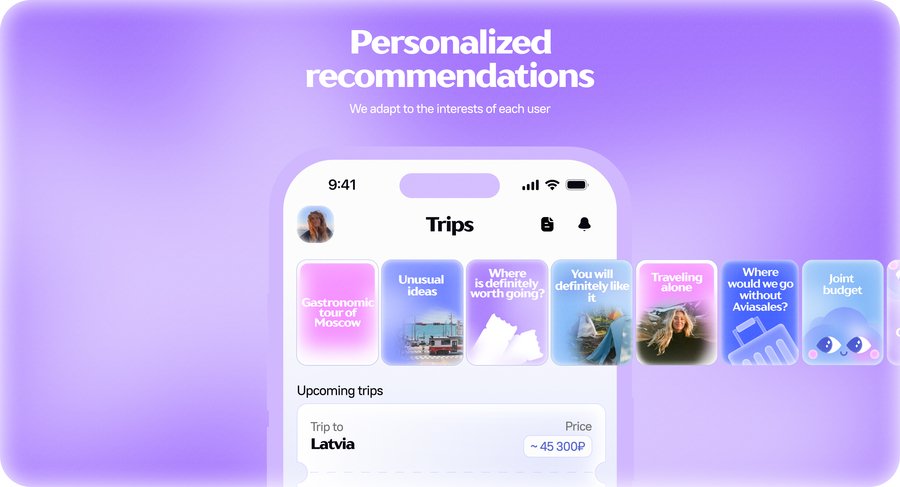
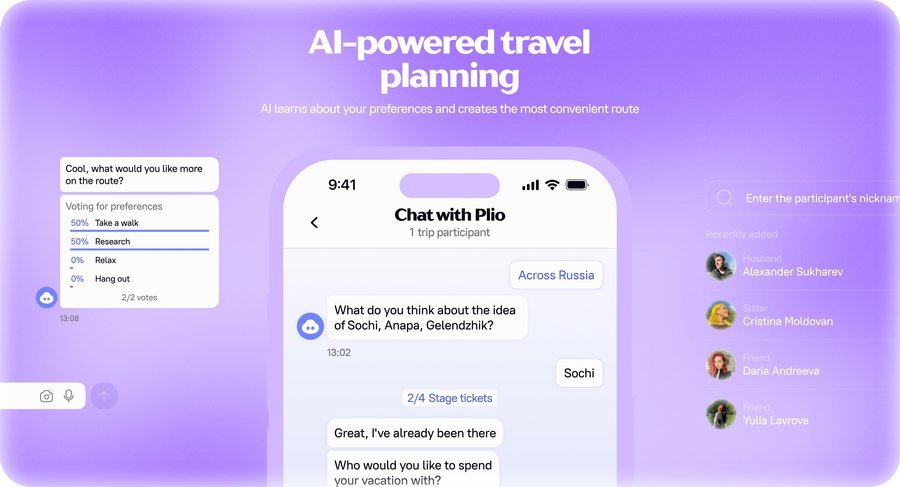

Here’s how Plio fits into your trip:
You share the basics Tell Plio where you’re going, when, who you’re traveling with, and what you’re in the mood for — museums, food, nature, nightlife, slow rest, or all of it.
Plio compares and optimizes It looks across different options to help you find smarter ways to buy tickets, choose routes, and stay within your budget — without you spending hours researching.
It turns your chaos into a clear plan Plio suggests where to stay, what to see, and how to move around the city. You can adjust everything: remove, swap, or add new ideas in seconds.
It travels with you Plans change? Weather turns bad? Someone suddenly wants to go somewhere else? Plio adapts your route on the fly and offers alternatives, so nothing breaks the trip.
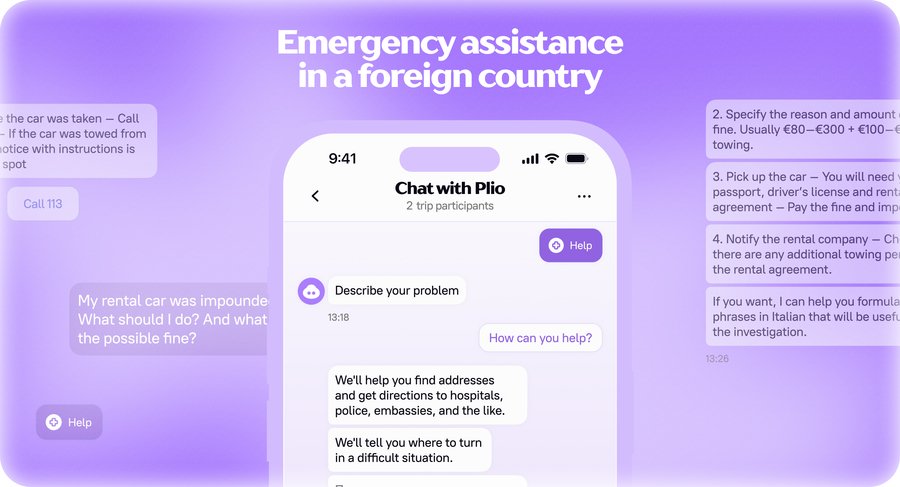
It helps when you don’t know how Don’t speak the language? Unsure how to handle a local situation? Ask Plio — it helps you find the right words, places, contacts, or instructions.
Traveling with friends or family?
— Plio becomes your neutral «trip manager»: — Collects preferences from everyone — Balances different budgets and interests — Offers options you can vote on together — Reduces arguments and «who forgot to book this?» moments
Why people enjoy using Plio
Less stress, more clarity No more jumping between dozens of sites. You see your whole trip in one place.
Smarter choices without extra work Plio looks for better routes and options — you just confirm what feels right.
Flexible, not rigid Your plan is alive: easy to change, update, and adapt on the go.
Support in unfamiliar situations From language tips to local advice, Plio helps you feel less lost in a new country.
Good for solo trips and big companies Whether you’re going alone, with a partner, or with a noisy group of friends — Plio scales with you.
We believe travel should feel like freedom, not like project management. Join us as we build a way to plan trips that feels human, simple, and actually enjoyable.
Plio — you travel, it takes care of the rest
Presentation for professional audience
Plio constructs a communicative environment in which travel planning unfolds as a dialogue rather than a sequence of instructions. The system is designed to be perceived not as a neutral tool, but as a communicative presence that accompanies the user throughout the decision-making process. Through conversational interaction, pauses, clarifications and suggestions, Plio creates a sense of interpersonal engagement in which the user feels addressed, heard and responded to. The AI does not simply deliver information; it participates in meaning-making, adapting to emotional cues, uncertainty and changing intentions.
Interpersonal & non-verbal communication: emotional user–AI presence
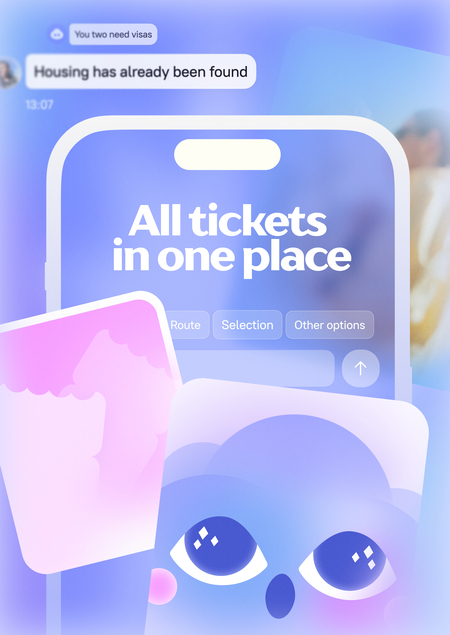
This sense of presence is reinforced through non-verbal communication embedded in the interface. Soft shapes, rounded cards, fluid motion and gentle transitions lower cognitive load and reduce anxiety commonly associated with planning. Color gradients and pastel tones function as emotional signals rather than decorative elements, conveying calmness, care and openness. Together, these visual choices form a non-verbal layer of communication that supports trust and emotional safety before any explicit dialogue takes place.
The color palette and the mascot further extend this non-verbal communicative layer. Soft blue and violet tones communicate calmness, reliability and emotional balance, while gentle pink accents introduce warmth and empathy. Rather than encoding strict functional states, colors operate as an affective language that subtly guides perception and mood. The mascot embodies this emotional grammar, translating the abstract logic of the system into a socially legible figure. Through facial expressions and states, the character communicates availability, uncertainty or reassurance without verbal explanation, reinforcing a sense of emotional attunement between the user and the system.