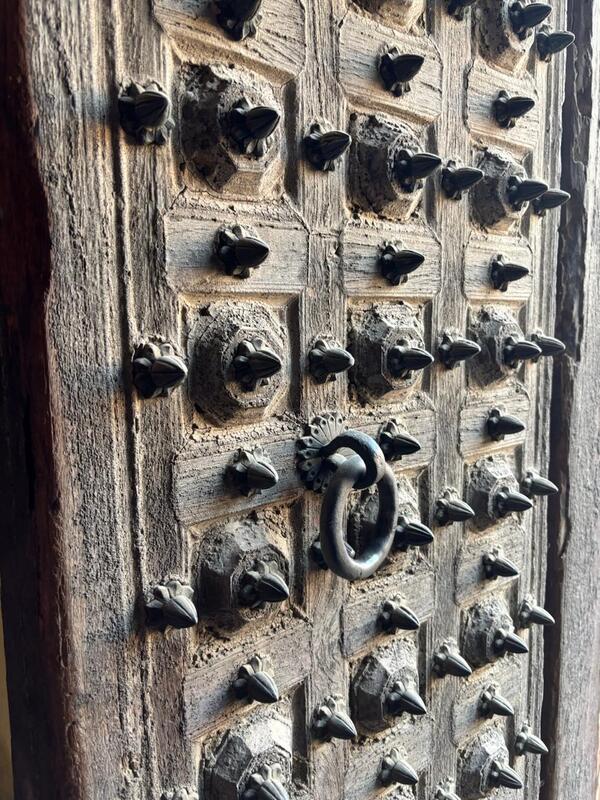
Designing with Time: A Climatic Reinterpretation of Kadipur Haveli Designing with Time began with a simple question: Can a building be considered futuristic if it cannot be reused, dismantled, or reinterpreted by the future? For me, futurism is not about dramatic forms or advanced technology, but about how long architecture can continue to exist and remain useful. This idea led me to study historic havelis, especially the Kadipur Haveli in Delhi. I first visited the site, carefully observed the building, and documented it in detail. Through this process, I realised how the haveli still performs climatically, structurally, and socially despite being built without modern tools or calculations. Its thick walls, openings, and material logic reflect an intuitive understanding of climate and human use.
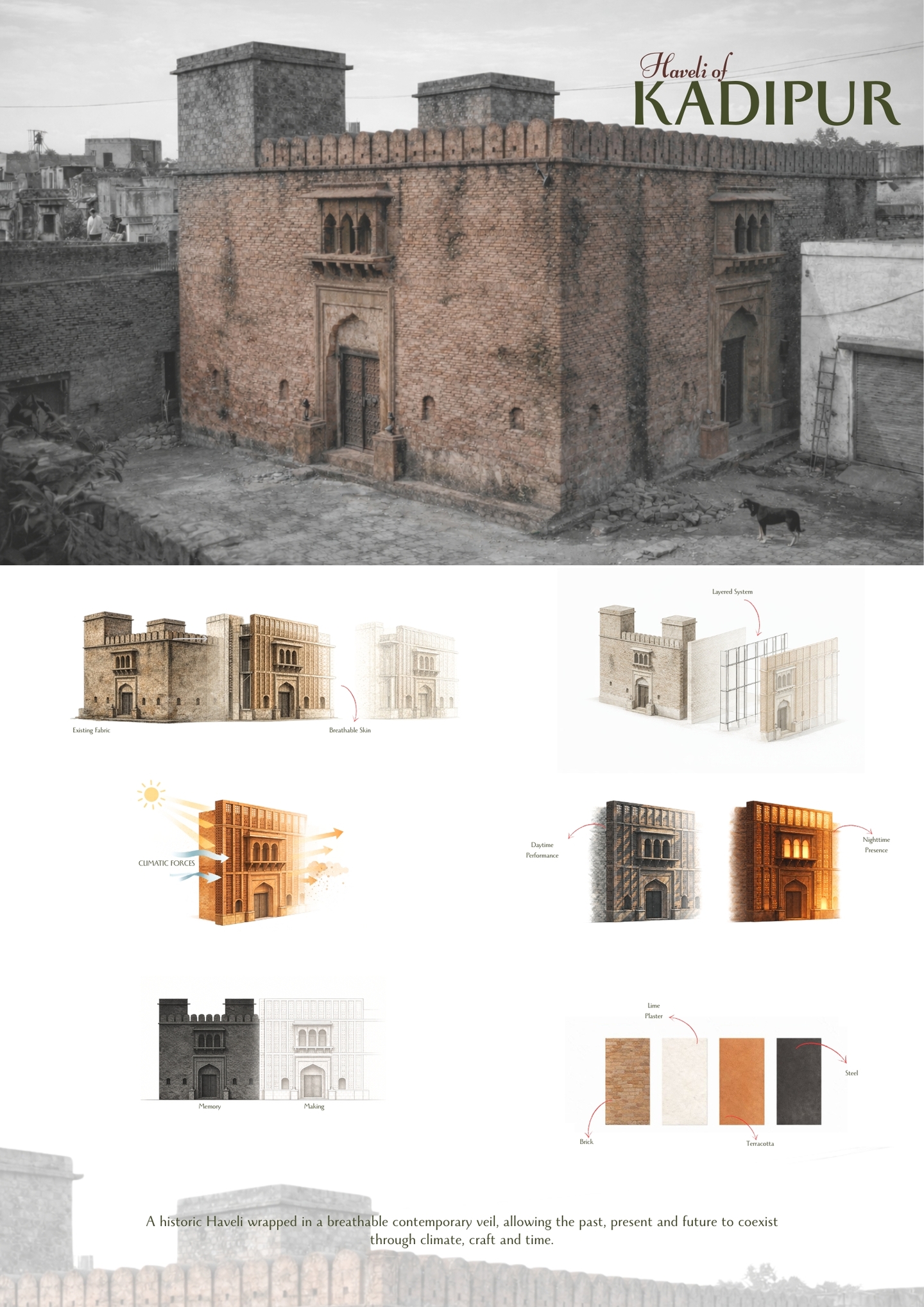
After documenting the building, I recreated it as an accurate three-dimensional model in SketchUp, making sure that its proportions, massing, and openings remained exactly the same. I then spent time researching how I wanted the facade to feel rather than how it should look, focusing on restraint, climate responsiveness, and continuity instead of decoration. AI was used as a design tool to explore and test these ideas. Through carefully written prompts such as «Reimagine this building to be relevant to the past, present and future.» and «Architectural concept illustration showing a historic haveli facade with a second, lighter layer emerging in front, represented as a semi-transparent terracotta Jaali outline, ” I explored how a secondary layer could work with the existing structure. This thinking was developed further through „Exploded axonometric architectural diagram separating the historic brick wall, air gap, steel frame, and terracotta Jaali into clear layers, ” and finally visualized through „Photorealistic architectural visualization of a historic Indian haveli after sensitive adaptive reuse, where the original brick remains dominant and a secondary terracotta Jaali act as a breathable climatic skin.“
The final proposal introduces a lightweight, reversible facade that responds to light, heat, dust, and airflow while leaving the original haveli untouched. In this way, the project does not design over history, but designs with time, allowing the building to move forward without losing its past.