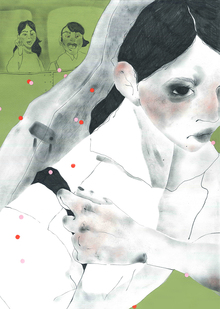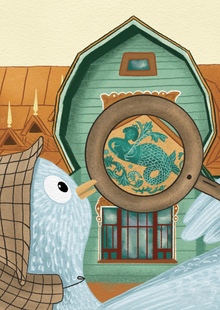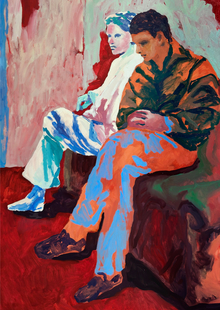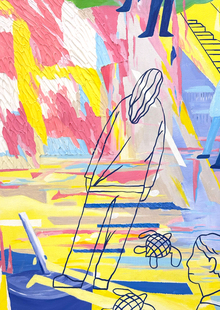
This illustration series serves as a window into the authentic lives of Slavic mythical entities, documenting their existences as defined by the ancient legends and folklore that birthed them. Each illustration captures these beings not as figures of an external story, but as characters living out the very essence of their lore. Each were a visual illustration that demonstrate every mythological creature have their own story to make them life between folklore told from generation to generation, these entities exist solely within the boundaries of their own supernatural reality.
The viewer is pulled into the deep, breathing heart of the old world. Demonstrating that every mythological creature possesses their own intricate thread of life passed down through generations, this series proves that these entities do not merely inhabit stories they exist solely and powerfully within the boundaries of a mythic reality that continues to whisper to those who dare to look.
Leshy: Guardian Spirit of The Forest
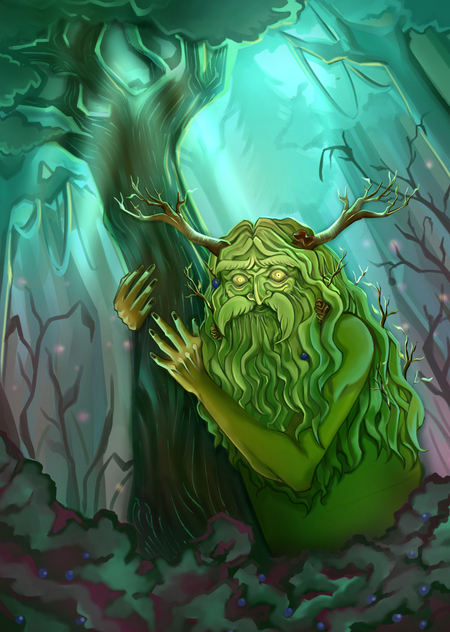
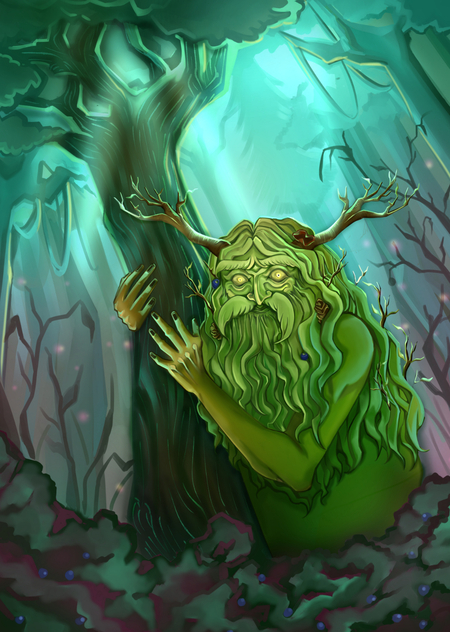
As the guardian spirit of the forest. Leshy, depicted as a tall and hairy figure with a long beard. In this Illustration he is not walking openly but is hiding. He is positioned behind a cluster of thick tree trunks, peering out with eyes that glow with magical fire. His gaze is fixed on an unseen presence, monitoring their every move. The central symbolic action is Leshy embracing or hugging a large tree. This gesture is not out of fear but serves as a powerful visual representation of his role as the forest’s guardian, showing his intimate connection and protective stance over the forest.
Rusalka: The Lake’s Cold Embrace
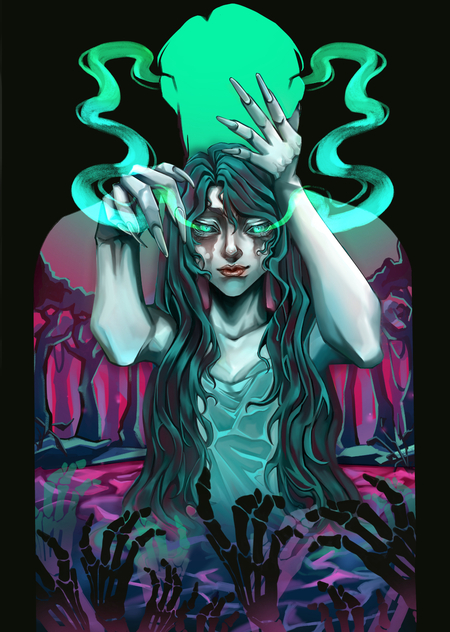
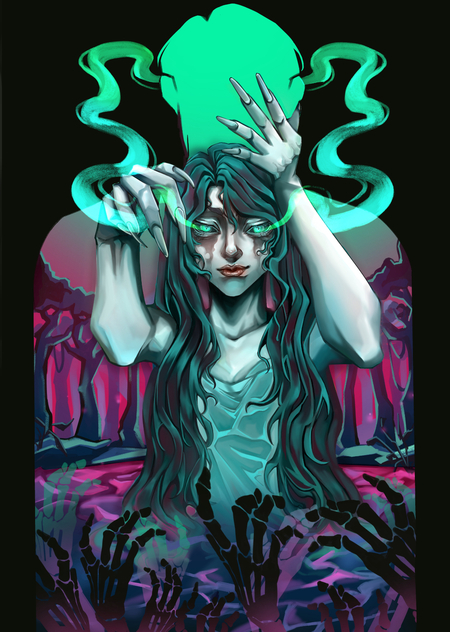
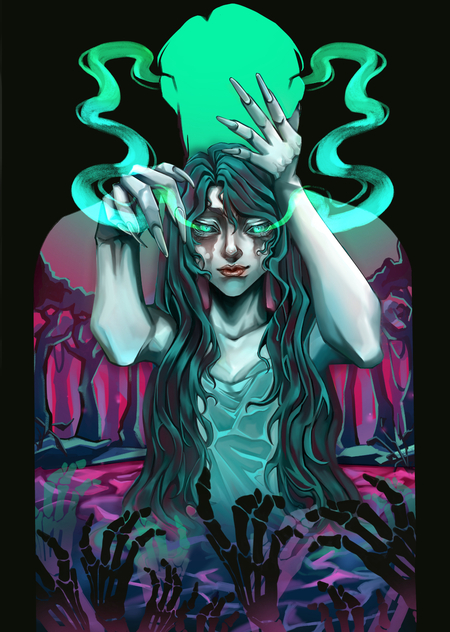
Titled the Lake’s Cold Embrace, this illustration captures the haunting, tragic, and predatory essence of the Rusalka under the cover of night. Set within a secluded forest lake, the Rusalka is depicted with a deathly pale complexion, serving as a grim reminder of her own demise by drowned. She is seen from the perspective of the shadow of a man from behind, locked him in a deceptive embrace. The composition utilizes a perspective from behind the victim, allowing the audience to look through his silhouette and witness the exact moment he is ensnared. He is completely mesmerized, drowning in the spellbinding allure of her eyes, which burn with a malevolent green fire. Beneath the surface, the dark waters are filled with skeletal human hands the remains of her past victims, visually picturing the fatal consequence of her deceit and reinforcing her lore as a vengeful spirit who pulls the living into the abyss by luring people from the shore to drown.
Koschei: The Deathless
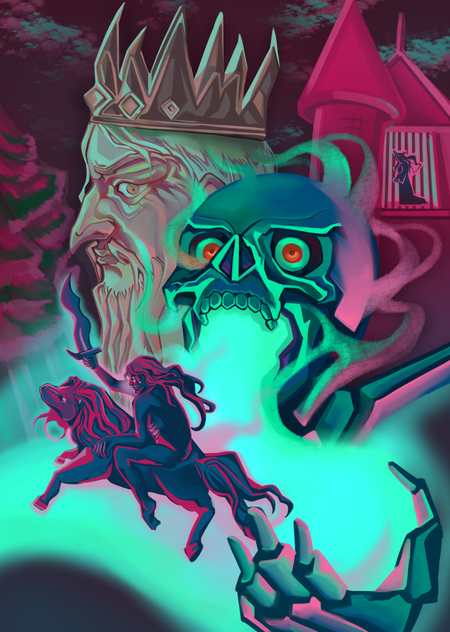
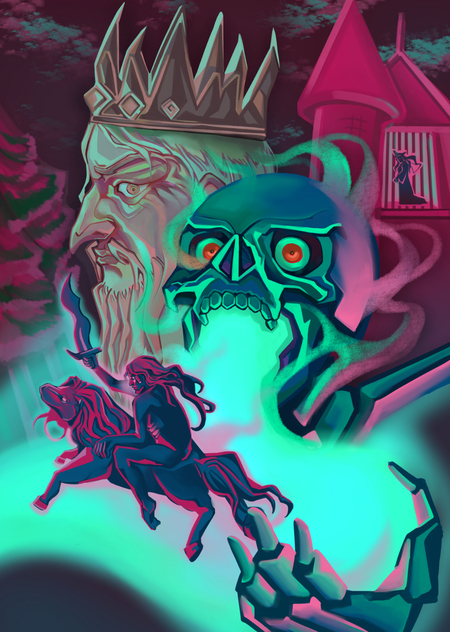
This illustration offers a psychological and symbolic portrait of Koschei, the infamous sorcerer of Slavic folklore. The central figure is depicted in profile, casting an arrogant, intensely antagonistic glance that projects his absolute malice and perceived superiority. This outward arrogance, however, is a shield for his deepest vulnerability a crippling fear of mortality. He visually looks at the audience as if he is sent a warning to anyone who harm his immortality. Beside him, there’s a witness of a visual manifestation of his soul being extricated from his corporeal form a representation of his desperate act to hide his mortality. This spectral soul path opens up a vision of Koschei himself, riding naked atop a charging steed and brandishing a sword toward the heavens. This chaos ride serves as a metaphor represents the sheer lengths he will go to guard, conceal his hidden soul and fighting anyone who seeking hidden soul to bring him to the death. To the right, looming in the background, stands his cold, desolate fortress, where the silhouette of a captive woman is visible behind iron bars capturing his lore as a ruthless abductor who imprisons youth within his icy domain.
Kikimora: The Unwanted Housekeeper
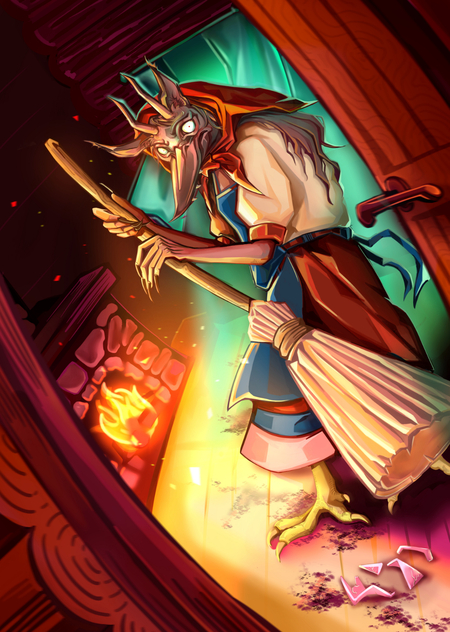
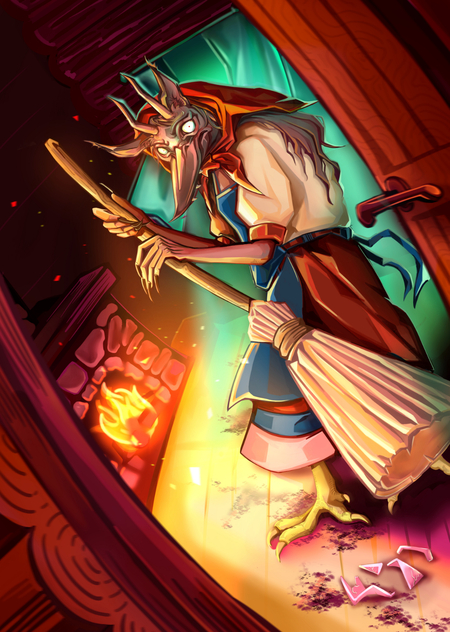
This illustration frames the malevolent and chaotic nature of the Kikimora through an immersive, first-person perspective. The viewer acts as the homeowner, looking through a cracked-open door to witness a chilling domestic intrusion. She catches the viewer looking, locking eyes with a piercing, venomous stare that radiates pure malice and resentment. Positioned in front of a glowing hearth, the Kikimora depicted as grotesque looking woman clutches a broom, capturing her twisted tie to household chores as a house spirit. Behind her, an open window with wind-blown curtains billows, visually establishing the narrative that she has sneaked into the house under the cover of night. At her feet lies shattered dishes on the floor and dirt under her feet a direct manifestation of her wrath and her disdain for the household’s upkeep, symbolizing her legendary habit of harassing people by making noise, knocking on walls, disrupting sleep, and breaking dishes to inflict nightmares upon the inhabitants who keep the house unorganized and dirty.
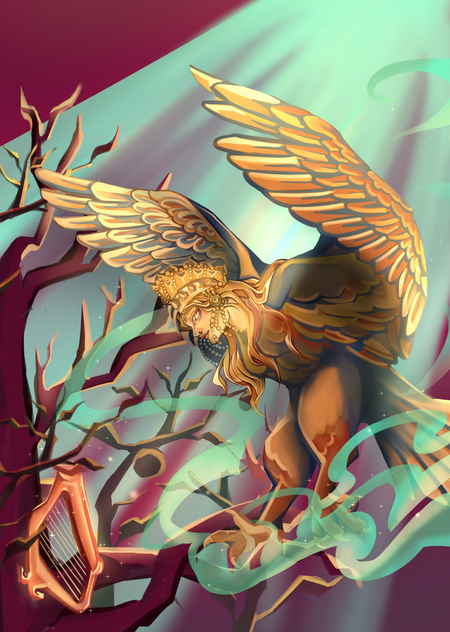
Sirin: Bliss Beyond The Clouds
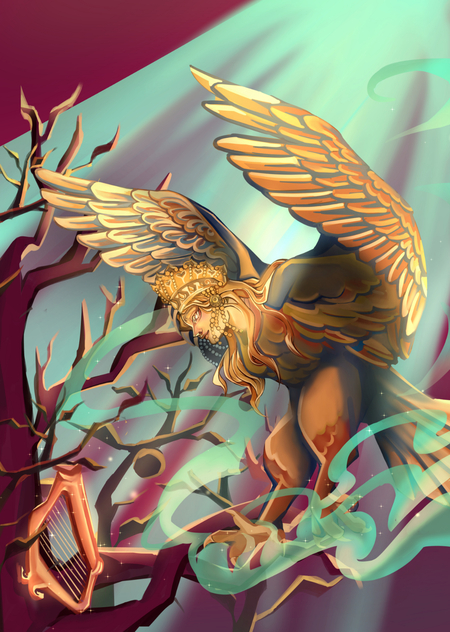
This illustration explores the ethereal, seductive, and self-absorbed nature of the Sirin, an avian-human hybrid of Slavic mythology. The composition captures the exact moment she descends from the heavens, gracefully about to alighting upon a gnarled tree branch. Above her, the sky breaks open with a divine, radiant luminosity, visually anchoring her lore as a creature originating from the celestial gardens of paradise. The focal point of her attention is a golden harp, discovered nestled among the branches. Sirin gazes upon the instrument with a look of pure euphoric bliss. This interaction is a metaphorical about how she views the harp not merely as an object, but as a mirror of her own existence. In the harp, she recognizes her own elegance, beauty, and the enchanting melody that defines her. This joyful gaze symbolizes her absolute self-awareness of her fatal charm, a beauty and voice so mesmerizing that any mortal who hears it is driven to absolute ruin.
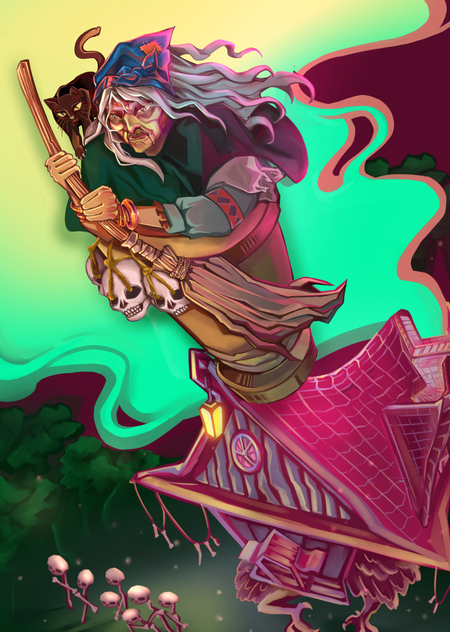
Baba Yaga: Where the Wild Woods Whispers
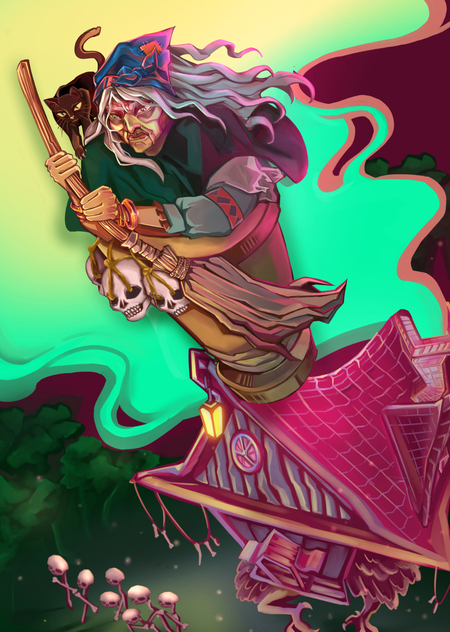
Titled Where the Wild Woods Whisper, this illustration capturing the flight of Baba Yaga above her sentient domain. The title evokes a forest that is alive, teeming with ancient secrets and hidden dangers and Baba Yaga is the ruler of these whispering woods. illustration pictured as Baba Yaga is legendary and ambiguous witch of Slavic folklore. As she ascends into the night sky aboard her stone mortar, she rises through a trail of chimney smoke that seems to carry the very whispers of the forest below. She rises through a dense trail of chimney smoke that twists around her like a spectral escort. Perched upon her shoulder is her loyal black cat, an animal familiar that anchors her connection to the dark arts. In her hands, she tightly grips her broom, to steer and propel her mortar through the air. The mortar itself is grimly adorned with human skulls, a direct visual encoding of her reputation as a fearsome cannibal. Far below, deep within the tangled wilderness of the forest, her sentient hut on chicken legs actively stalks her path, its perimeter fortified by a gruesome fence of human bones and skulls, which reinforces the terrifying and predatory narrative of her domain.