1. Concept 2. The essence of spectral composers' artistic techniques, using the examples of Gérard Grisey and Tristan Murail 3. Analysis of the architecture of the Basilica Cistern in Istanbul 4. Graphic score 5. Conclusion
Concept
In this study, I will primarily examine the compositional techniques of spectral composers, using Gérard Grisey and Tristan Murail as examples. For Grisey, duration and timbral transition are often important components of composition, based on a detailed structural analysis of the sound spectrum. He uses microscopic analysis of spectra with an analysis of harmonics, noise and artefacts. Murail works with sound as a temporal fabric, composed of macro and micro timbral layers.
Spectral music examines sound and its resonances in detail, breaking them down into spectra, which allows for a deep and somewhat ‘meditative’ immersion into the nature of sound. The works of spectralists emphasise timbre, amplitude and pitch fluctuations. Composers use gradual frequency transformations, microtonal shifts, and spectrum filtering. The listener, in turn, perceives sound as physical and psychoacoustic matter. Along with timbre, the space of sound reproduction, resonance and reverberation, and the duration of sound are also important in spectralism.
Therefore, in this study, I will also consider the architectural space that graphically and physically correlates with the compositions of spectralists — the Basilica Cistern in Istanbul. This choice is justified by the acoustics of the room — it is an underground water reservoir with stone arches and columns. In such acoustics, one can immerse oneself more deeply in listening to spectral compositions, because the resonances of the cistern delay low frequencies by tens of milliseconds.
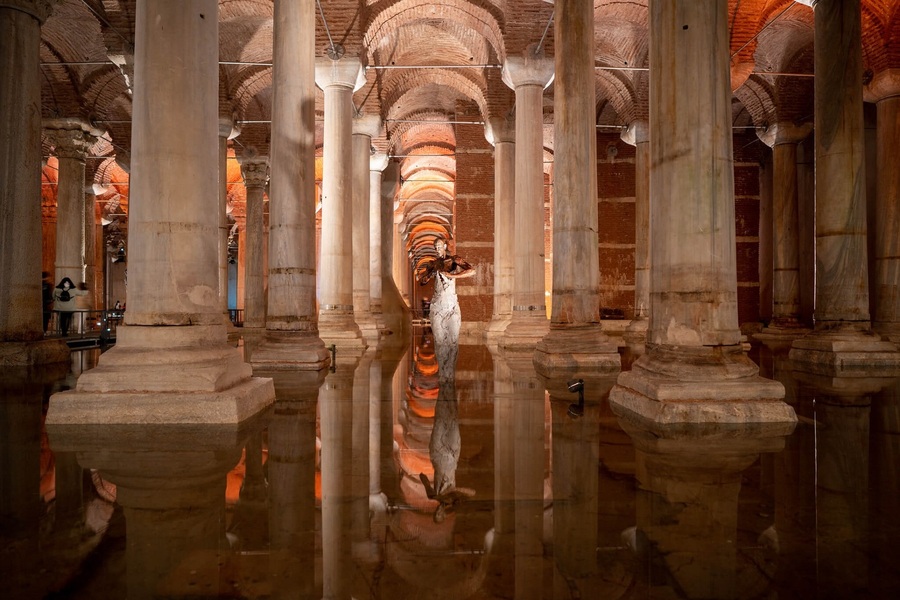
Basilica Cistern in Istanbul
With this kind of acoustics, you can immerse yourself more deeply in listening to spectral compositions, because the resonances of the tank delay low frequencies for tens of seconds, and reflections form complex timbres.
The basilica is seen not as a place of performance, but as an active component of a composition in which the physical characteristics of the space interact with the temporal and sonic processes of music. Studying the resonances of the space, mapping them, and visualising spectral transformations allows us to understand how architecture and music interact at the level of sound physics and psychoacoustics.
This comparison helps to understand spectralism as a direction where sound, space, and perception are all parts of a single continuum of composition. In other words, the concept of my work combines the sound thinking of spectralists, microscopic analysis of acoustics and timbres, and the experience of space.
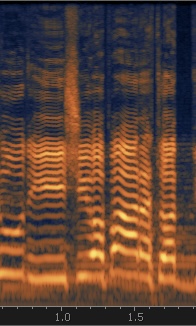
Spectrogram of a violin playing a note and then a pure fifth above it, with common overtones highlighted by white lines.
At the end of the study, I composed a graphic score for spatial spectral improvisation in the Basilica, where each participant works on a specific resonance zone. String instruments form a slow drone texture, while wind instruments create a contrasting texture with an interesting timbre. Moving through space reveals a variety of spectra and also requires more detailed ‘microscopic listening.’
An important detail of the score is reflection. In the architecture of the cistern, reflection is a characteristic element of space that not only creates echoes but also triggers complex cross waves that interact with the original sound. Therefore, I graphically represented the direction of reflections, the trajectory of energy distribution, and time delays, which allowed me to transform architectural characteristics into ‘musical’ elements.
I graphically represented the direction of reflections, the trajectory of energy distribution, and time delays, which allowed me to transform architectural characteristics into ‘musical’ elements.
Gérard Grisey
Gérard Grisey (1946–1998, France) graduated from the Paris Conservatory, where he studied with Olivier Messiaen. He also studied electronic composition with Jean-Étienne Marie, Karlheinz Stockhausen, Iannis Xenakis, and György Ligeti. Grisé subsequently trained at the IRCAM centre under David Wessel and Marc Battier.
During his residency at the Villa Medici in Rome, Gérard met Tristan Murail, which led to the formation of a joint group, L’Itinéraire. They were also joined by Roger Tessier and Michaël Levinas.
Gérard Grisey
Grize: ‘We are musicians, and our model is sound, not literature, mathematics, theatre, visual art, quantum physics, geology, astrology or acupuncture.’
Griese’s artistic language is attributed to the spectralism movement, which he formed in collaboration with Murray. Composers explore the spectra of overtone timbres and noise. Their compositions often develop slowly and gradually, so that the listener’s attention is focused on the structure of the sound itself rather than the composition.
Griese said, ‘We are musicians, and our model is sound, not literature, mathematics, theatre, visual art, quantum physics, geology, astrology or acupuncture.’
Les Espaces Acoustiques (1974–1985)
Time is an important element in Gérard Grisey’s compositions. In his compositions, the duration of sound and changes in timbre are directly related to the acoustic space of performance. Specifically, in the cycle Les Espaces Acoustiques (1974–1985), the six parts of the composition unfold through gradual transitions from instrumental solos to the full orchestra. And every harmony, every sound component and every echo in space becomes a functional element of the musical form.
Below is an example of the composition being performed at the Moscow Philharmonic.
Partiels
Partiels is one of Gérard Grisey’s earliest major works. The spectral analysis is based on the sound of a double bass (the note E), which undergoes timbral transformation throughout the composition. The composition is built on spectral analysis. A group of orchestral instruments repeats the exact spectrum of the double bass sound with all its overtones and artefacts.
The sound gradually unfolds in terms of timbre and amplitude.
It is interesting that the performance space has a significant impact on the outcome of the composition, as different resonances affect the sound spectrum in different ways.
For example, in a standard concert hall with a large stage and audience, the reverberation is often in the range of 1.5–2.5 seconds, which: — stretches the low harmonics of the bass in time — makes the harmonics clearly distinguishable — makes woodwind instruments less prominent — makes brass instruments and percussion sound brighter — results in moderate reverberation overall and limited spatial reflections
Below is a spectrogram of this performance of ‘Partiels, ’ which shows the repetition of the spectral pattern of the double bass sound throughout the composition. And despite the bass sound, there are quite a few prominent mid-frequencies in the spectrum.
Spectrogram of ‘Partiels’ by J. Grisey, performed in a concert hall from Audacity
In other words, Grise combines the analysis of sound perception and the practice of its performance in his works. At the same time, the acoustics of the performance venue act as an active element of the score. His works create a feeling of inner immersion in spectral processes, in which the listener witnesses the transformation of microscopic details of sound over time, similar to certain architectural forms and materials that create unique acoustic effects.
Tristan Murail
Tristan Murail, along with Gérard Grisey, is recognised as one of the founders of spectral music. Murail’s main idea is that the analysis of a single sound — its spectrum, amplitude-frequency structure and dynamic properties — can serve as the basis for a complete composition. The microcosm of timbre is transformed into the macrocosm of the work, and the instrumental synthesis of sound and its spectral transformation create a mobile and sparkling higher timbre.
Tristan Murail