The Body in 20th-21st Century Art: Representation of Skin, Age, and Body Texture
Rubricator
1. Concept 2. Structure 3. Introduction 4. Skin and Wound 5. Age as Visible History 6. Texture 7. Conclusion 8. Bibliography 9. Image Sources
Concept
The study «The Body in 20th-21st Century Art» analyzes how the concept of the human body has evolved in modernist and contemporary art. The project’s central idea is to understand the body not as a classical object of representation, but as a space in which personal, social, political, and cultural processes are recorded. In 20th-21st century art, the body ceases to be merely an anatomical form or an idealized image of the human being. Artists begin to view it as a surface of memory, a bearer of trauma, a field of conflict, and simultaneously a language of visual expression.
The path to this topic began with a visual study of works in which the body is depicted as unstable, vulnerable, or deformed. Initially, attention focused on images of physical wounds and distorted flesh in the works of Egon Schiele, Frida Kahlo, and Francis Bacon. However, during the analysis, it became clear that corporeality in contemporary art is not limited solely to the theme of pain. In works of the second half of the 20th century and the early 21st century, the body is beginning to be perceived as a medium of memory, time, identity, and cultural pressure. It was this observation that allowed the research topic to expand and move beyond the idea of "wound» to a more complex understanding of the body as a multilayered surface.
The next step was to compile a body of works for analysis. The selection of works was based not on chronological principles, but on visual and conceptual intersections. The study included painting, photography, performance, sculpture, and installation. An important selection criterion was the works' particular relationship to the body: its deformation, fragmentation, aging, texture, or transformation into a cultural object. Thus, the study brought together artists from different eras and movements.
After selecting the works, a visual and formal analysis was conducted. Each work was examined through several aspects: composition, color, scale, texture, the relationship of figure and space, and the symbolic meaning of the image. The historical and cultural context of the work’s creation was also considered. This method revealed that the body in 20th- and 21st-century art is gradually losing its sense of integrity. Artists increasingly depict it as an unstable structure, subject to time, violence, social norms, and technological change. During the analysis, a central research question emerged: how do 20th- and 21st-century artists transform the body into a vehicle of cultural, psychological, and social meaning? This question became the foundation of the entire structure of the work and determined the subsequent division of the material. To more precisely explore the topic, the study was divided into three chapters. This division is driven not only by the convenience of analysis but also by the logic of the development of the very idea of corporeality in contemporary art.
The first chapter, «Skin and Wound,» examines the body as a site of trauma and vulnerability. It analyzes works in which the wound becomes a central image, both physical and psychological. Works by Schiele, Kahlo, Panet, Mendieta, and ORLAN depict the body as an open conflict between the human interior and the external world. This chapter is essential, as it is through the theme of the wound that 20th-century art radically disrupts the classical image of the body for the first time.
The second chapter, «Age and the Memory of Time,» examines the body as a space of time. In the works of Alice Neel, Lucian Freud, John Coplans, Duane Hanson, and Evan Penny, artists address aging, wrinkles, the heaviness of flesh, and the natural changes of the human body. This section of the study demonstrates that contemporary art rejects the cult of youth and the idealization of the body, replacing them with a focus on the reality of human existence.
The third chapter, «Texture,» examines the body as a cultural construct. Here, materials, textures, and decorative elements play a significant role. Artists use wax, silicone, rhinestones, collage, patterns, and artificial surfaces, transforming skin into a vehicle for social and political messages. Works by Jenny Saville, Louise Bourgeois, and Mickalene Thomas demonstrate how the body in the 21st century is becoming a site of intersection between questions of identity, gender, postcoloniality, and technology.
Thus, the structure of the study reflects the gradual transformation of the image of the body in 20th-21st century art. All chapters are linked by a common idea: contemporary art no longer perceives the body as a neutral form. It is becoming a text, an archive of experience, and a space for visual expression.
Structure
An introduction with a statement of questions and a description of methodology, three main thematic chapters, a comparative synthesis, and conclusions. In the «Skin/Wound» section, I analyze works that emphasize traumatization and the fragility of the body. In the «Age» section, I examine works on the inevitability of time, aging, and the wear and tear of flesh. In the «Texture» section, I examine works that use skin as a material and political artifact.
Key question: How do 20th-21st-century artists, through their techniques and subject matter, transform the body from an object of traditional depiction into a surface bearing traces of pain, time, and social symbolism?
Introduction: Issues and Methodology
I formulate three central questions:
How are the themes of wounds and bodily deformation treated in the selected works?
How do the artists depict aging and the body’s transformation over time?
How do texture, material, and decorative techniques inform the artist’s depiction of the body?
Skin and wound (images of injury and deformation)
In this group, the skin is no longer so much a «shell» as a place of rupture: where the body begins to hurt, deform, open up, or become a witness to external violence.
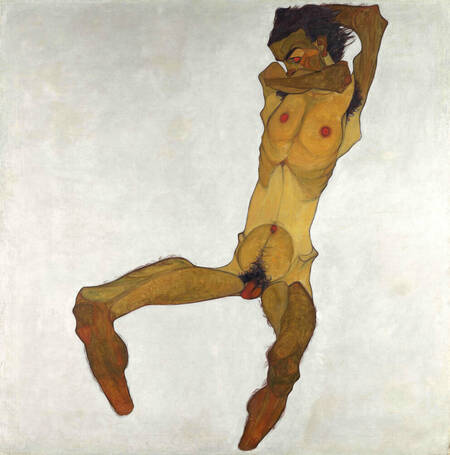
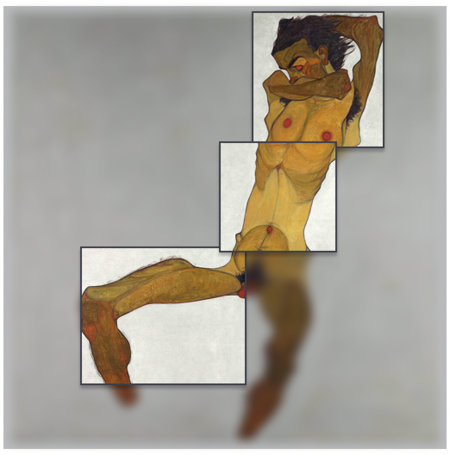
Egon Schiele, Seated Male Nude (Self-Portrait), 1910
The figure of a young man against a white background is depicted with pronounced sagging skin and a reddish flush to his face. The composition is central: the subject sits in profile, but his gaze is turned toward the viewer. The colors are muted. The thin skin, through which veins and bones are visible, is striking. This choice is determined by fear and despair: judging by the self-portrait, Schiele perceived his body as wounded. Analyzing this work, it is clear that the artist does not strive for idealization; on the contrary, he shows the body as an anatomical landscape of pain. This is consistent with the views of Expressionism, where a wound is a projection of the artist’s internal conflict.
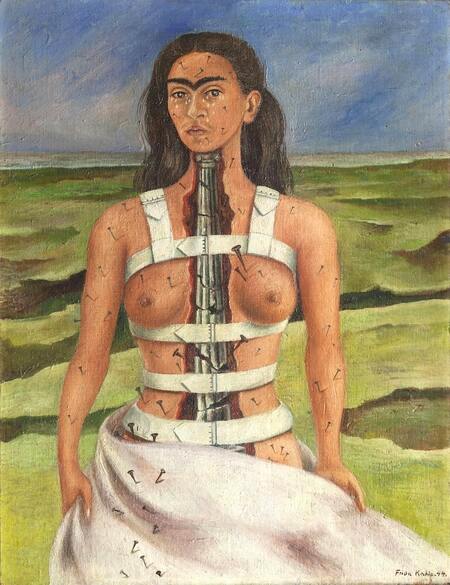
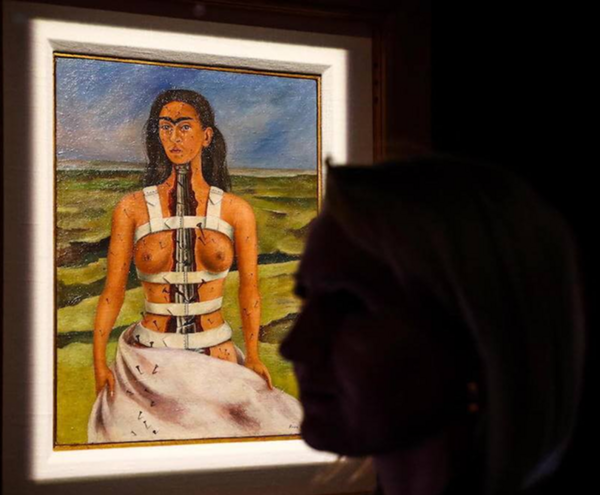
Frida Kahlo, The Broken Column, 1944
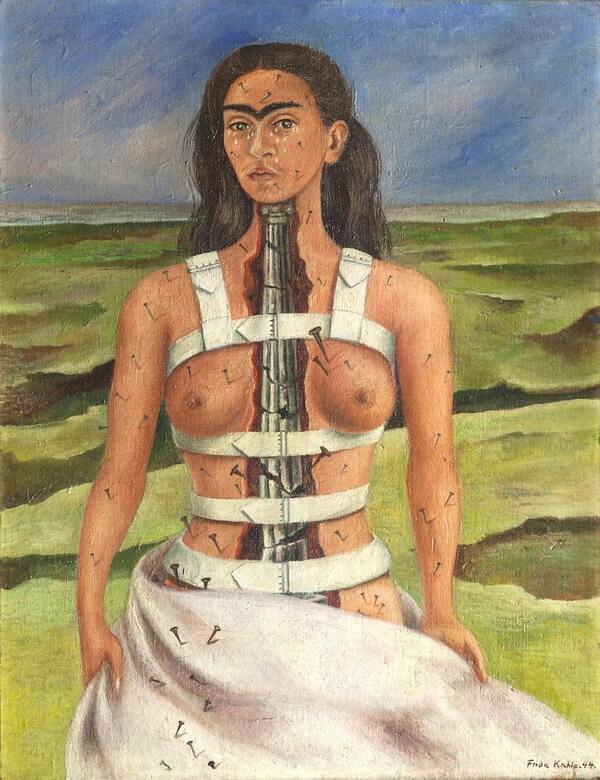
In the portrait, Kahlo stands naked in a corset, her spine shaped like a cracking Ionic column. Her face and body are streaked with drops of blood and embedded nails, and tears stream down her cheeks. The style is conventionally realistic, the scale is small, and the background is desolate and cold. Kahlo combines in a single image biographical trauma (after the accident, she wore a corset for a long time) with allegory (the column as a symbol of a shattered core). The artistic effect—the static nature of the scene amidst internal tension—suggests the idea of "a roof under which we do not hide»: the body here is exposed and vulnerable. «Broken Column» appears as a classic illustration of trauma: the rupture of the skin and the body’s structure reveals that the wound is embedded in the very fabric of reality.
Francis Bacon, Figure with Meat, 1954
The painting depicts an old man sitting on a chair, with two enormous pieces of meat hanging on either side. The colors are earthy, brownish, and the blood stains are uneven. The meat, roughly cut from the carcass, almost «grows» to the body. Human flesh clings to the bloody meat, as if suggesting the sacred sacrifice of the body. Visually, longing and alienation are felt. In the composition, the human and the meat are of equal importance. The figure with the meat demonstrates that a rupture of the body does not always bleed outwardly: here, the wound is a process of the flesh being animated and mortified. In the context of post-war philosophy, Bacon shatters the familiar body, replacing it with the otherworldly colorlessness of flesh.
Kiki Smith, Sueño, 1992
I place this engraving next to the wounded images, although there is no blood. Against a light background, there is a line drawing of a woman, her body filled with the image of muscles and veins. The composition is static: the outline is carefully delineated, and within the sketch, the internal layers of the body are outlined with a reddish-burgundy line. The color is very restrained, almost monochrome, with the emphasis on the reddish muscles. The style is reminiscent of anatomy textbooks. Smith «pulls» the skin, effectively removing its internal «skeleton» from the volume of flesh. This move is interpreted as a reduction of the body to its essential energy. «Sueno» demonstrates that a wound can also be like this: the beautiful outer layer disappears, leaving behind the naked truth of the muscles.
Gina Pane, Action Escalade non-anesthésiée, 1971
A series of photographs shows the artist herself climbing a ladder with sharp edges. Her hands and feet are visible clinging and clawing. The images themselves are impeccably documentary, the background undistracting. Skin literally tears against the metal before our eyes. Pane herself becomes a «canvas» for a brutal performance.
Ana Mendieta, Untitled (Glass on Body Imprints), 1972
A series of photographs depicting a woman’s body pressed against a transparent glass. Her face is distorted by the pressure. Mendieta appears as a fragile vessel, easily broken—the wound here is created by the environment.
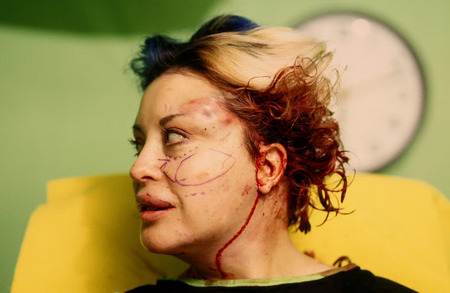
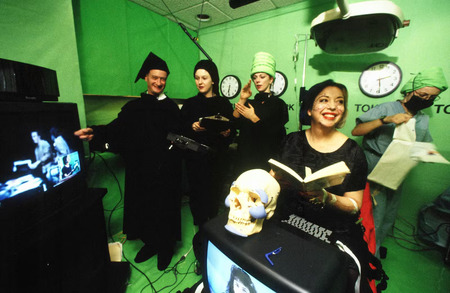
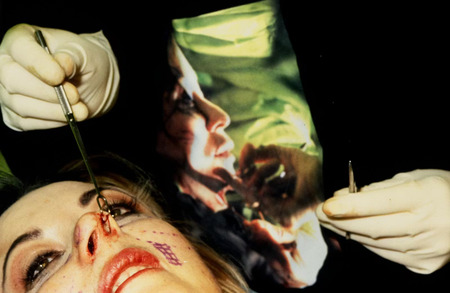
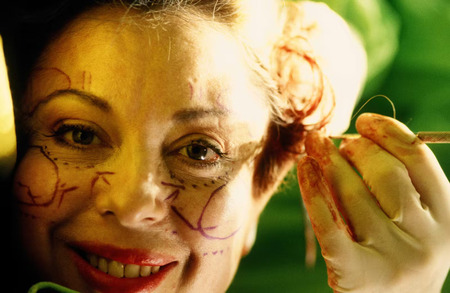
ORLAN, OMNIPRÉSENCE II, 1993
The artist’s face before and after plastic surgery. The colors are cool, the composition symmetrical. The scars and stitches are visible.
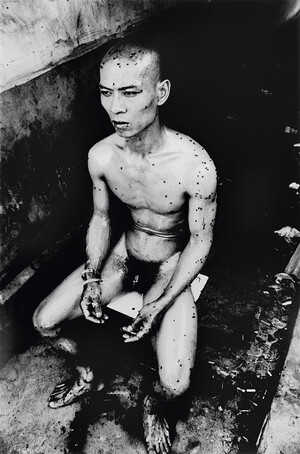
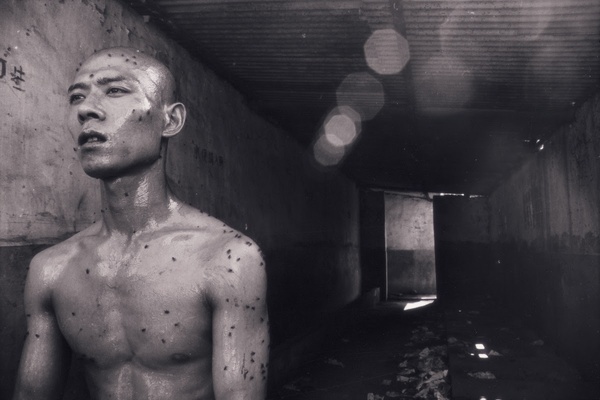
Zhang Huan, 12 Square Meters, 1994
The performance, captured in a photograph, features the artist sitting in an outdoor toilet, his body covered in honey and fish. The technique is a physical execution: the wound is metaphorical—the complete dissolution of the body into the surrounding filth. Zhang evokes the perception of the body as a haven of infection and humiliation.
In the «Skin/Wound» section, the works are united by the theme of the injured body. The artists use the image of a physical or psychological wound to highlight the fragility of human nature. Common techniques include a central composition, a flat, neutral background, a close-up of the figure, and cool, pale or flesh-toned colors. The wound motif also changes context across eras: early modernism symbolizes the wound as a metaphor for suffering, while later artistic practices make the wound an active experience (displaying blood, stitches, and scars).
Age as visible history
In the «Age/Memory» section, I examine works that express the passage of time through the body. The artists depict old age and wear: wrinkles, sagging, the heaviness of flesh. These are often large-scale works or hyperrealistic life-size sculptures, with an emphasis on detail. This is a protest against the idealization of youth.
Alice Neel, Self-Portrait, 1980
Neel paints herself nude, her gaze direct and calm, directed at the viewer. The striped chair and open pose strip the scene of heroic pathos. The painting is free but not softening: the stomach, breasts, arms, and face are depicted without any attempt to «improve» the body. The work is significant in that the aging female body becomes a central, rather than marginal, image. Neel herself states: old age is part of the truth.
John Coplans, Torso, Front, 1984
The head is cut off, and so the psychological portrait disappears: the viewer is confronted only with folds, hair, and the heaviness of the surface. The black-and-white palette transforms the body almost into an abstract relief. A naked faceless figure. The body appears like a statue, but with the marks of time.
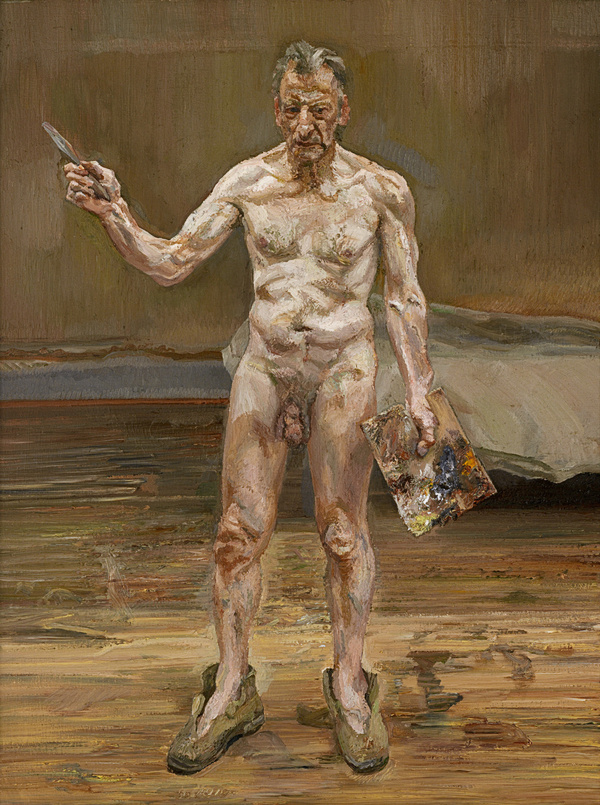

Lucian Freud, Painter Working, Reflection, 1993
The figure is painted with heavy, viscous paint, and this is precisely what makes old age almost physically palpable. The body’s surface is composed of gray-pink and greenish brushstrokes, rather than a smooth outline. The work translates age into the language of pictorial mass and prolonged contemplation of the surface.
Ron Mueck, Two women, 2005
In Mueck’s work, aging takes on a hyperrealistic intimacy. Two small figures are pressed together. The reduced scale of the figures and their combination of suspicion and vulnerability create a powerful contradiction. Their small size doesn’t make the figures any less powerful; on the contrary, it heightens the sense that one must get close and literally read the wrinkles, hair, fabric, and gazes. The work makes old age material and at the same time deeply human.
Duane Hanson, Old Couple on a Bench, 1995
A hyperrealistic polychrome sculpture of an elderly couple on a bench. The sculpture looks like a casually glimpsed scene from life: clothes, glasses, a bag, a tired sitting posture. It is precisely the absence of dramatic gesture that makes the work powerful: old age here is an ordinary mode of bodily existence. The work depicts age as the heavy, familiar materiality of everyday life.
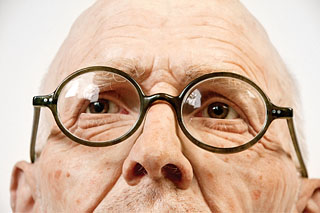
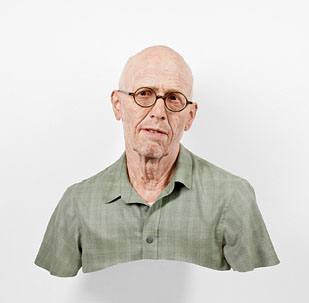
Evan Penny, Old Self: Portrait of the Artist as He Will (Not) Be. Variation #2, 2010
This isn’t just an old person, but a simulated version of their own future face. 3D imaging was used to predict aging. The realism of wrinkles, pigmentation, and hair is combined with a strong sense of technological distance: age is constructed. Old age is shown as an image created from a photograph, a scan, and sculptural detailing.
These works share a common theme: the rejection of the ideal. The artists depict the body as it is, emphasizing the imperfections of aging. Formally, similarities are noticeable: the realism of detail in Freud, Penny, Hanson, and Coplans, the hyperrealism of Mueck and Penny, and the frontal pose of Neel. These works confirm that in contemporary art, old age is a theme that demands artistic reflection. They emphasize the importance of aging as a part of life.
Texture as an independent meaning
The «Texture» section focuses on how the outer layers of skin become meaningful. Artists use materials and patterns to emphasize ideology or aesthetics. Common threads include a focus on texture and the blending of cultural codes.
Jenny Saville, Shift, 1996–97
The enormous canvas depicts intertwined bodies. The composition is square, without a background, and fragmented bodies are depicted large. The paint is applied in thick brushstrokes, almost like tangible mounds. This work emphasizes flesh. Areas of brushstroke build up, forming muscles and wrinkled bodies.
Berlinde De Bruyckere, Into One-Another II To P.P.P., 2010
A sculpture made of waxed polycarbonate. The surface is pale yellow, with red hues from bruises. Seams and cracks are visible, as if the bodies were joined together from different sections. The artist emphasizes the wounds not through blood, but through the scar texture; the sections and folds of the body are visible from the outside. The wax surface imparts a muted sheen and a reminder of the aging of the material.
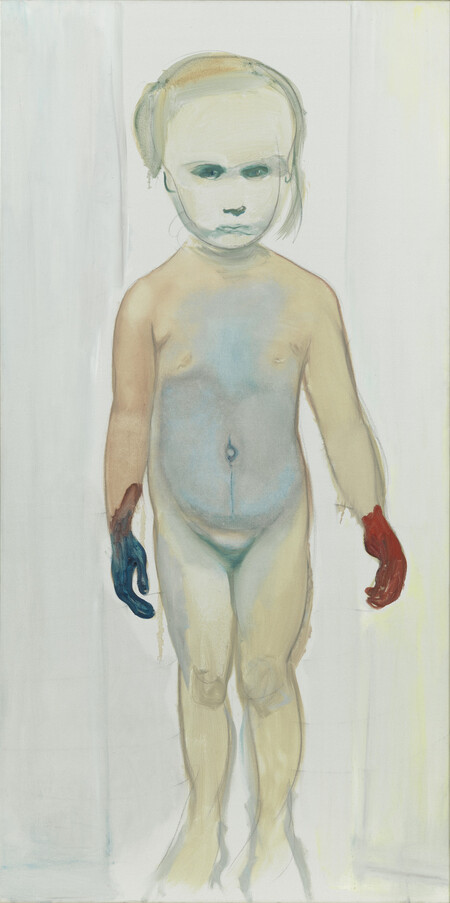
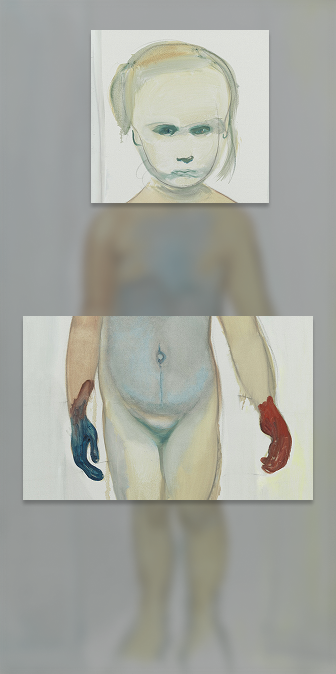
Marlene Dumas, The Painter, 1994
On a tall, narrow canvas, the silhouette of a girl with blurred features and a background of pink and blue spots. The paint is applied thinly, blurring the transitions. The skin has an ethereal, weightless effect. The girl is seen frontally, her face barely legible—only blurred shadows. Dumas blurs the boundaries of texture: the body is not clearly defined here, but rather blurred in color. In this way, she demonstrates that skin is a field of emotions and memories.
Louise Bourgeois, Arch of Hysteria, 1993
A suspended bronze figure of a woman in extreme arched posture. The arched shape of the body depicts spasm and pain. The smooth surface reflects light, emphasizing the tension within. Here, skin as such is eliminated, replaced by metal. The contrast between the surface and the form heightens the sense of inner pain.
Patricia Piccinini, The Young Family, 2002
The skin of the casts is pale, almost translucent, with visible veins. The mother gently embraces her cubs. The skin here is at once semi-mechanical and very sensual. The body is unfamiliar to us, but the attachment is strong.
Mickalene Thomas, A-E-I-O-U and Sometimes Y, 2009
A pop art portrait of a young African American woman: her face, hands, and body are embellished with colorful rhinestones. The shape of the face and contours are emphasized with glitter; body parts like the chest and shoulders are covered in large geometric shapes. The material is asphalt paint and rhinestones. The skin sparkles, but it’s artificial. It demonstrates that body beauty is also a matter of presentation, of layering.
Conclusion
Comparing the three groups, we can reach the following conclusions. Common elements: most paintings feature a central figure, a static pose, a large scale, a limited palette, and contrasting accents. This brings together the works of different artists: frontal compositions in Schiele, Kahlo, Neel, and Hanson; non-sexual, analytical, rather than sexual, nudity in Saville, Panet, and Dumas.
Differences by era: the early century (Schiele, Kahlo) — expressionism and the symbolism of pain. The 1970s–1990s (Pane, Mendieta, Neel, Coplans) — an increasingly real body, a transition to performance. The 21st century (Saville, Piccinini, Thomas, Kher) — the body blurs into texture and becomes an arena for social signs. The style of the early works is painterly, abstract; the style of the later works is mixed, postmodern.
The body in these works is transformed into a bearer of traces—it metaphorizes social and personal experiences through visual wounds and decorative surfaces. The plain white canvases of Schiele and Neel emphasize the intensity of the experience, while the shiny layered materials of Thomas and Orlana highlight the complexity of the cultural layer.
The analysis revealed that contemporary art uses the body as a field for expressing meaning.
Malinina N.L. Corporality in Contemporary Culture: Between Domestication and Rebellion. 2020.
Rozin V.M. Corporal Practices as a Social and Visual Phenomenon. 2022.
Sitnikov F.S. On the Relationship between Corporality and Society in Contemporary Art. CyberLeninka, 2020.
Toropova I.V. Construction of Performative Corporality in Contemporary Art. 2017.
Stroeva O.V. The Hyperrealistic Body in Contemporary Art. e-notabene, 2018.
Leopold Museum. Description of «Seated Male Nude (Self-Portrait)». Online Collection, 2018.
MoMA. Description of «Portrait of the Artist» (Marlen Dumas). — Online collection, n.d.
Smithsonian NPG. Description of «Self-Portrait» by Alice Neel, 1980. — Online collection, n.d.
Metropolitan Museum of Art. Description of «Torso, Full Face» (John Coplans), 1980. — Online collection, n.d.
Gagosian. Catalogue of the exhibition «Jenny Saville: Territories», 1999.
MoMA. Brief description of «Sciencia» (Maria Lassnig), 1998. — Online collection, n.d.
Palm Springs Art Museum. Press release «Duane Hanson, The Old Couple on a Bench» (1995).
Crystal Bridges Museum. Interview with Evan Penny on «Old Self» (2021).
National Galleries of Scotland. «Histology of…Tumors» page (2004–05).
QAGOMA. Description «The skin speaks a language not its own» (Bharti Kher, 2006).
Barbican Centre. Material from the exhibition «A Countervailing Theory» (Toyin Ojih Odutola, 2019).
National Museum of Women in the Arts (NMWA). Description of «The Young Family» (P. Piccinini, 2002).
National Museum of Women in the Arts. Description of «A–E–I–O–U and Sometimes Y» (M. Thomas, 2009).
LACMA. Description of «Portrait as a Shadow» (K. J. Marshall, 1980).
https://artsandculture.google.com/asset/12-square-meters-video-still-zhang-huan/hQGPkmELB9mh-g?hl=en